


Page 166 - Mechanics of Microelectromechanical Systems
P. 166
3. Microsuspensions                                               153


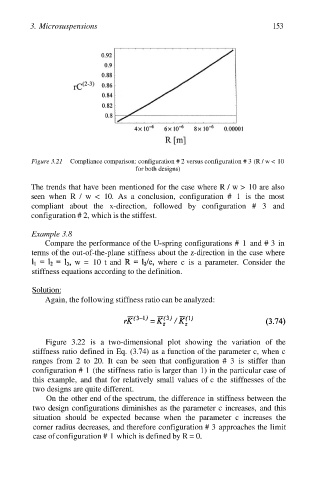
         Figure 3.21 Compliance comparison: configuration # 2 versus configuration # 3 (R / w < 10
                                      for both designs)

         The trends that have been mentioned for the case where R / w >  10 are also
         seen  when R  /  w  <  10.  As a  conclusion, configuration #  1  is  the  most
         compliant about the  x-direction,  followed by  configuration #  3 and
         configuration # 2, which is the stiffest.

          Example 3.8
             Compare the performance of the U-spring configurations #  1  and # 3 in
          terms of the out-of-the-plane stiffness about the z-direction in the case where
                     w =  10 t  and         where  c  is  a  parameter.  Consider  the
          stiffness equations according to the definition.

          Solution:
             Again, the following stiffness ratio can be analyzed:


             Figure 3.22 is  a  two-dimensional  plot  showing the  variation  of the
          stiffness ratio defined in Eq. (3.74) as a function of the parameter c, when c
          ranges  from  2 to 20.  It  can  be  seen  that  configuration #  3  is stiffer  than
          configuration # 1 (the stiffness ratio is larger than 1) in the particular case of
          this example,  and that for relatively small values of c the stiffnesses of the
          two designs are quite different.
             On the other end of the spectrum, the difference in stiffness between the
          two design configurations diminishes as the parameter c increases, and this
          situation should be  expected because  when the  parameter  c  increases the
          corner radius decreases, and therefore configuration # 3 approaches the limit
          case of configuration # 1 which is defined by R = 0.

