


Page 341 - Mechanics of Microelectromechanical Systems
P. 341
328                                                         Chapter 5
         which is also the solution for a straight beam of length l.


         7.3     Post Buckling and Large Deformations

             The critical load is found by means of the small-displacement theory‚ and
         this cannot  predict the  displacement/deformations of  a beam-column  at
         buckling or  for conditions  where the axial  load exceeds  the  critical value.
         However‚ as  mentioned  previously‚ MEMS applications are  being
         specifically designed to produce large output displacement through buckling
         and  therefore knowledge of the true  deformation of a  buckled  member is
         important. By using the large-deformation theory it is possible to predict the
         so-called post-buckling behavior of a microcomponent‚ as shown  next.


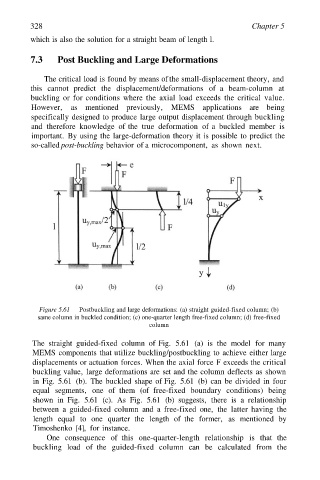
            Figure 5.61  Postbuckling  and large deformations: (a) straight guided-fixed column; (b)
           same column in buckled condition; (c) one-quarter length free-fixed column; (d) free-fixed
                                         column

          The straight  guided-fixed  column of Fig.  5.61  (a)  is  the model  for  many
          MEMS components that utilize buckling/postbuckling to achieve either large
          displacements or actuation forces. When the axial force F exceeds the critical
          buckling value‚ large deformations are set and the column deflects as shown
          in Fig.  5.61  (b).  The buckled  shape of Fig.  5.61  (b) can be divided in  four
          equal segments‚  one  of them  (of  free-fixed boundary conditions) being
          shown in  Fig.  5.61 (c).  As  Fig. 5.61 (b)  suggests‚  there is  a  relationship
          between a  guided-fixed column  and a  free-fixed  one‚ the  latter having  the
          length equal  to one  quarter  the  length  of  the former‚  as mentioned by
          Timoshenko  [4]‚ for instance.
              One consequence  of  this one-quarter-length  relationship  is that  the
          buckling  load of  the  guided-fixed  column can be calculated from  the

