


Page 343 - Mechanics of Microelectromechanical Systems
P. 343
330                                                        Chapter 5
          times the length of the free-fixed microcolumn‚ which gives a value of
                   for the sought maximum postbuckling deflection.

          8.     COMPOUND STRESSES AND YIELDING

          8.1    Introduction


             Often  times‚ normal and tangential stresses are  produced  concomitantly
          in deformable  MEMS  components. In  such  cases‚ the  loading produced
          through actuation needs to  ensure that the  microcomponents that do  deform‚
          do so within the elastic range‚ so that the part regains its original shape after
          loading is relieved‚ and that they do not fail.


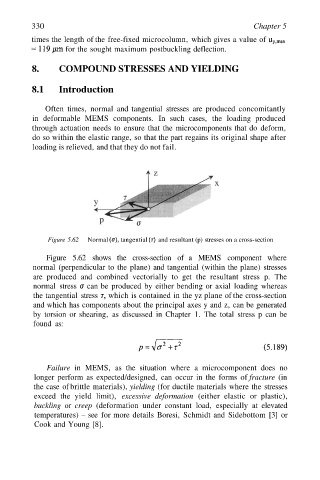
              Figure 5.62  Normal  tangential  and resultant (p) stresses on a cross-section

              Figure 5.62 shows  the cross-section of  a  MEMS  component  where
          normal (perpendicular to the plane) and tangential (within the plane)  stresses
          are produced  and  combined  vectorially to get the resultant  stress p.  The
          normal  stress  can  be  produced by either bending or axial loading  whereas
          the tangential  stress   which is contained in the yz plane of the cross-section
          and which has components about the principal axes y and z‚ can be generated
          by torsion or shearing‚ as  discussed  in  Chapter 1.  The  total  stress  p can be
          found as:


              Failure in MEMS‚  as the  situation where a  microcomponent  does no
          longer perform as expected/designed‚ can occur in the forms of fracture (in
          the case of brittle materials)‚ yielding (for ductile materials where the stresses
          exceed the  yield  limit)‚ excessive  deformation (either  elastic or  plastic)‚
          buckling or creep (deformation  under  constant  load‚ especially at  elevated
          temperatures) – see  for more details Boresi‚  Schmidt and Sidebottom  [3] or
          Cook and Young [8].

