


Page 347 - Mechanics of Microelectromechanical Systems
P. 347
334                                                         Chapter 5
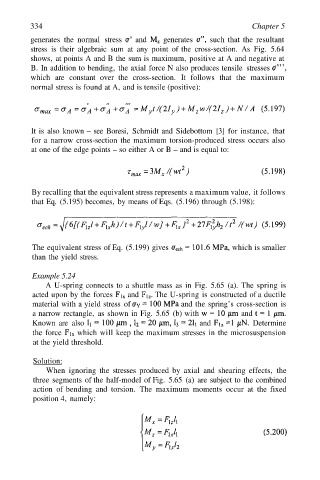
         generates the  normal stress  and   generates    such that the  resultant
         stress is  their algebraic  sum  at any  point of the  cross-section. As  Fig.  5.64
         shows‚ at points A and B the sum is maximum‚ positive at A and negative at
         B. In addition to bending‚ the axial force N also produces tensile  stresses
         which are  constant over  the  cross-section.  It  follows that  the  maximum
         normal stress is found at A‚ and is tensile (positive):


         It is  also known – see Boresi‚  Schmidt and Sidebottom  [3] for instance‚  that
          for a narrow cross-section the maximum torsion-produced  stress  occurs also
         at one of the edge points – so either A or B – and is equal to:


          By recalling that the equivalent stress represents a maximum value‚ it follows
          that Eq.  (5.195) becomes‚ by means of Eqs.  (5.196) through (5.198):


          The equivalent stress of Eq. (5.199) gives            which is smaller
          than the yield stress.

          Example 5.24
             A U-spring connects to a shuttle mass as  in  Fig.  5.65 (a).  The spring is
          acted upon by the forces  and    The  U-spring is constructed of a ductile
          material with a yield stress of         and the spring’s cross-section  is
          a narrow rectangle‚ as shown in Fig. 5.65  (b) with     and
          Known are also                               and           Determine
          the force   which will keep the maximum stresses in the microsuspension
          at the yield threshold.

          Solution:
             When ignoring  the  stresses  produced by  axial and  shearing effects‚  the
          three segments of the half-model of Fig. 5.65 (a)  are subject to the combined
          action of bending and  torsion. The  maximum  moments occur  at  the  fixed
          position 4‚ namely:

