


Page 339 - Mechanics of Microelectromechanical Systems
P. 339
326                                                         Chapter 5
             The advantage of  the curved design,  as  well as of  the  next  design
         presented  herein  (the  bent  beam  column),  over the  straight  configuration is
         that the curved beam-column produces buckling unidirectionally (outside the
         curvature  center), as  it  is improbable  that  buckling will  occur the other
         direction. This  feature can  be  used in applications  where buckling is  sought
         not to  take  place about certain directions,  such as  towards the substrate.  At
         the same  time, the  buckling  direction of  a  straight  beam-column is
         completely unpredictable.

         7.2.3   Bent Beam Columns


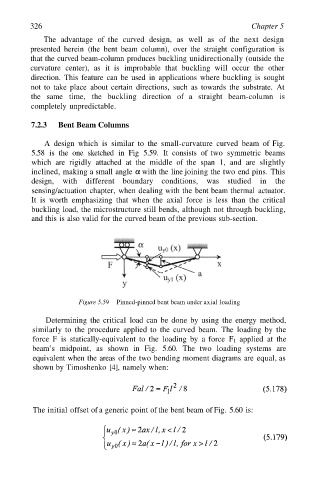
             A design  which  is  similar  to the small-curvature  curved beam of Fig.
         5.58 is  the  one sketched  in  Fig 5.59.  It  consists of  two  symmetric  beams
         which are rigidly  attached at  the  middle of  the  span 1,  and  are  slightly
         inclined, making a small angle  with the line joining the two end pins. This
         design,  with different  boundary  conditions,  was  studied in the
          sensing/actuation chapter, when dealing with the bent beam thermal  actuator.
         It is worth emphasizing that when the axial force is less than the critical
         buckling load, the microstructure still bends, although not through buckling,
          and this is also valid for the curved beam of the previous sub-section.


                      Figure 5.59 Pinned-pinned bent beam under axial loading


             Determining the critical  load can  be done by using the  energy method,
          similarly to  the procedure applied  to the curved  beam. The loading by the
          force F  is  statically-equivalent to the  loading by  a  force   applied  at  the
          beam’s  midpoint, as  shown in Fig.  5.60. The  two  loading  systems are
          equivalent when the areas of the two bending moment diagrams are equal, as
          shown by Timoshenko [4], namely when:


          The initial offset of a generic point of the bent beam of Fig. 5.60 is:

