


Page 156 - Methods For Monitoring And Diagnosing The Efficiency Of Catalytic Converters A Patent - oriented Survey
P. 156
138    Methods for Monitoring and Diagnosing the Efficiency of Catalytic Converters


                8) determining whether the catalytic converter is deteriorated, based on the calculated average
                  value and output fluctuation width


                In JP6193436 (1994) the engine air/fkel ratio forcibly varies from rich to lean and the opposite
                with a specific amplitude and frequency. The average engine air/hel ratio is set leaner than the
                stoichiometric value during execution of the perturbation.  The deterioration judgment  of the
                three-way  catalytic converter is then based on the average output signals of the upstream  and
                downstream sensor.


                 airlfuel correction


                                                                                      e


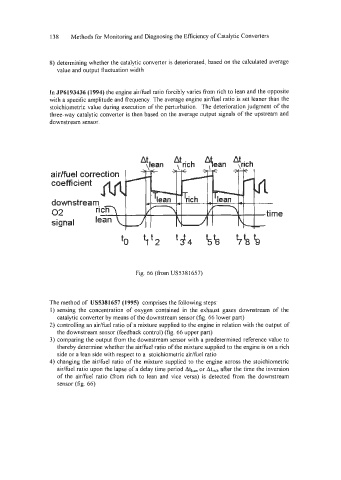
                                          Fig. 66 (from US5381657)


                The method of  US5381657 (1995) comprises the following steps:
                1)  sensing the  concentration  of  oxygen  contained  in  the  exhaust  gases  downstream  of  the
                  catalytic converter by means of the downstream sensor (fig. 66 lower part)
                2) controlling an airhe1 ratio of a mixture supplied to the engine in relation with the output of
                  the downstream sensor (feedback control) (fig. 66 upper part)
                3) comparing the output from the downstream sensor with a predetermined reference value to
                  thereby determine whether the aidfuel ratio of the mixture supplied to the engine is on a rich
                  side or a lean side with respect to a  stoichiometric aidfuel ratio
                4) changing the air/fkel ratio  of the mixture supplied to the engine across the stoichiometric
                  aidfuel ratio upon the lapse of a delay time period AtIan or   after the time the inversion
                  of the aidfuel  ratio  (from  rich  to lean  and  vice versa)  is  detected  from  the  downstream
                  sensor (fig. 66)

