


Page 168 - Methods For Monitoring And Diagnosing The Efficiency Of Catalytic Converters A Patent - oriented Survey
P. 168
150   Methods for Monitoring and Diagnosing the Efficiency of Catalytic Converters


                The method of EP0478133 (1992) comprises the following steps:
                 1) controlling the air/hel ratio of the air/fbel mixture supplied to each cylinder of the engine to
                   the stoichiometric value @=I)
                2) changing the  air/fuel ratio supplied  to  the engine from  one  predetermined rich  value to
                   another predetermined lean value around the stoichiometric one by means of a ;L correction
                   coefficient (fig. 69b) in such a way that the mean value is leaner than the stoichiometric one
                   (fig. 69c, left side), then
                3) changing the  aidfuel ratio  supplied  to  the engine from  one predetermined rich  value to
                   another predetermined lean value around the stoichiometric one by means of a 1 correction
                   coefficient (fig. 69b) in such a way that the mean value is richer than the stoichiometric one
                   (fig. 69c, right side)
                4)  measuring the response time At of the downstream sensor from the moment the mean value
                   of the air/fbel ratio supplied to the engine turns from lean to rich till the moment the signal
                   of the downstream sensor passes from lean to rich respectively (fig. 69d)
                5) deciding that the catalytic converter is deteriorated if the response time At  is lower than  a
                   predetermined threshold


                In the method of DE4238807 (1993) a cross-correlation function of the output signals of the
                upstream and downstream sensors is calculated in a way similar to the method of US5237818
                (1993)  described above. The correlation coefficient calculated from the two signals is averaged
                and  from  this  coefficient  an  averaged  conversion  efficiency  of  the  catalytic  converter  is
                estimated. This value of the conversion efficiency is compared to a predetermined region of
                values.  If  the  conversion efticiency  falls  out  of  this region  then  the  catalytic converter  is
                considered as deteriorated.


                The method of DE4243339 (1993) and US5341642 (1994) comprises the following steps:
                I)  calculating an auto-correlation fbnction @=of the output signal x from the upstream sensor
                  to output the maximum values of the auto-correlation function at predetermined intervals,
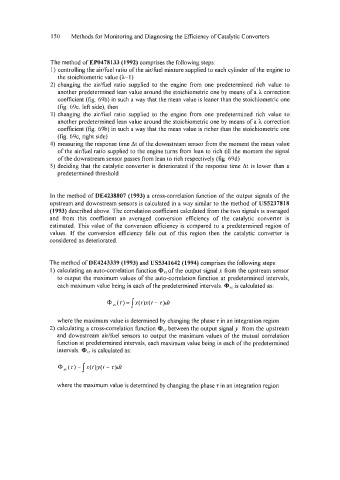
                  each maximum value being in each of the predetermined intervals. @=  is calculated as:


                  where the maximum value is determined by changing the phase 7 in an integration region
                2) calculating a cross-correlation hnction QAT.  between the output signal y  from the upstream
                  and  downstream aidfuel sensors to output the maximum values of the mutual  correlation
                  hnction at predetermined intervals, each maximum value being in each of the predetermined
                  intervals.   is calculated as:


                  where the maximum value is determined by changing the phase 7 in an integration region

