


Page 234 - Methods For Monitoring And Diagnosing The Efficiency Of Catalytic Converters A Patent - oriented Survey
P. 234
2 I6   Methods for Monitoring and Diagnosing the Eficiency of Catalytic Converters


                 1)  perturbing the oxygen concentration of the exhaust gas entering the catalytic converter such
                   that the concentration repeatedly alternates between a rich and a lean value
                2) counting the number of transitions of the gas leaving the catalytic converter in response to a
                   predetermined number  of transitions of the gas entering the catalytic converter and  if  a
                   faulty catalytic converter is indicated then
                3) integrating the oxygen concentration of gas leaving the catalytic converter while the oxygen
                   concentration of gas  entering the  catalytic converter  is  less  than  a  first  predetermined
                   oxygen concentration
                4)  repeating  the  previous  step  for  a  predetermined  number  of  transitions  of  the  oxygen
                   concentration of the gas leaving the catalytic converter
                5) summing the integrals E(AA.)i  calculated at steps 3 and 4 to form a first sum
                6) correcting the first sum for engine load and for gas flow entering the catalytic converter so
                   as to form a corrected value
                7) subtracting the  corrected value  from  a  first  predetermined  threshold  E] to  form  a  first
                   difference
                8) repeating steps 3 to 7 a predetermined  number of times and forming a second sum of the
                   first differences
                9) comparing the second sum with a second predetermined threshold EZ and
                 10) indicating the catalytic converter to be faulty when  the second sum exceeds the second
                   predetermined threshold ~2


                   Magneti Marelli S.p.A.


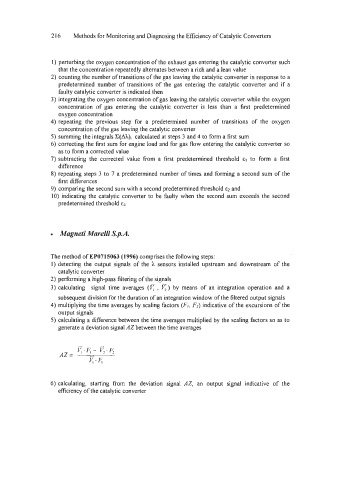
                The method of EP0715063 (1996) comprises the following steps:
                 1)  detecting the  output signals  of the  A.  sensors installed  upstream and  downstream  of  the
                   catalytic converter
                2) performing a high-pass filtering of the signals
                3) calculating  signal  time  averages (E , E) by  means  of an  integration  operation and  a
                   subsequent division for the duration of an integration window of the filtered output signals
                4) multiplying the time averages by  scaling factors (F,. F2) indicative of the excursions of the
                   output signals
                5) calculating a difference between the time averages multiplied by the scaling factors so as to
                   generate a deviation signal AZ between the time averages


                6) calculating,  starting  from  the  deviation  signal  AZ,  an  output  signal  indicative  of  the
                   efficiency of the catalytic converter

