


Page 157 - MODELING OF ASPHALT CONCRETE
P. 157
Complex Modulus fr om the Indir ect Tension Test    135


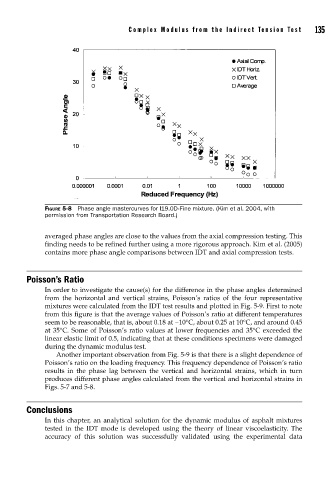
                    FIGURE 5-8  Phase angle mastercurves for I19.0D-Fine mixture. (Kim et al. 2004, with
                    permission from Transportation Research Board.)


                    averaged phase angles are close to the values from the axial compression testing. This
                    finding needs to be refined further using a more rigorous approach. Kim et al. (2005)
                    contains more phase angle comparisons between IDT and axial compression tests.


               Poisson’s Ratio
                    In order to investigate the cause(s) for the difference in the phase angles determined
                    from the horizontal and vertical strains, Poisson’s ratios of the four representative
                    mixtures were calculated from the IDT test results and plotted in Fig. 5-9. First to note
                    from this figure is that the average values of Poisson’s ratio at different temperatures
                    seem to be reasonable, that is, about 0.18 at −10°C, about 0.25 at 10°C, and around 0.45
                    at 35°C. Some of Poisson’s ratio values at lower frequencies and 35°C exceeded the
                    linear elastic limit of 0.5, indicating that at these conditions specimens were damaged
                    during the dynamic modulus test.
                       Another important observation from Fig. 5-9 is that there is a slight dependence of
                    Poisson’s ratio on the loading frequency. This frequency dependence of Poisson’s ratio
                    results in the phase lag between the vertical and horizontal strains, which in turn
                    produces different phase angles calculated from the vertical and horizontal strains in
                    Figs. 5-7 and 5-8.

               Conclusions
                    In this chapter, an analytical solution for the dynamic modulus of asphalt mixtures
                    tested in the IDT mode is developed using the theory of linear viscoelasticity. The
                    accuracy of this solution was successfully validated using the experimental data

