


Page 187 - MODELING OF ASPHALT CONCRETE
P. 187
VEPCD Modeling of Asphalt Concr ete with Gr owing Damage      165


                    been proven valid for asphalt concrete by Chehab et al. (2002) for tension and by others
                    in compression (Zhao 2002; Gibson et al. 2003; Kim et al. 2005).
                       The underlying principles of the VEPCD model have been characterized and
                    verified in the last 15 years through a series of research projects, and readers are referred
                    to the reports (Kim and Lee 1997; Kim et al. 2002; Kim and Chehab 2004; Kim et al. 2005)
                    and dissertations (Chehab 2002; Daniel 2001; Lee 1996) for theoretical details of these
                    principles. In the following sections, these principles are briefly described.

                    TTS with Growing Damage
                    It is well known that the behavior of asphalt concrete depends on time and temperature
                    and that, when in its linear viscoelastic range, asphalt concrete is thermorheologically
                    simple (TRS); that is, the effects of time or frequency and temperature can be expressed
                    through one joint parameter. The viscoelastic material property as a function of time (or
                    frequency), such as the relaxation modulus (or dynamic modulus) at various temperatures
                    can be shifted along the horizontal log time (or log frequency) axis to form a single
                    characteristic mastercurve. If this principle can be extended to outside of the LVE range,
                    its impact is significant in terms of testing requirements and efficiency in modeling.
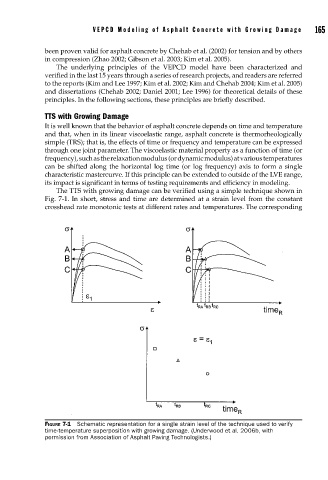
                       The TTS with growing damage can be verified using a simple technique shown in
                    Fig. 7-1. In short, stress and time are determined at a strain level from the constant
                    crosshead rate monotonic tests at different rates and temperatures. The corresponding


                    FIGURE 7-1  Schematic representation for a single strain level of the technique used to verify
                    time-temperature superposition with growing damage. (Underwood et al. 2006b, with
                    permission from Association of Asphalt Paving Technologists.)

