


Page 191 - MODELING OF ASPHALT CONCRETE
P. 191
VEPCD Modeling of Asphalt Concr ete with Gr owing Damage      169


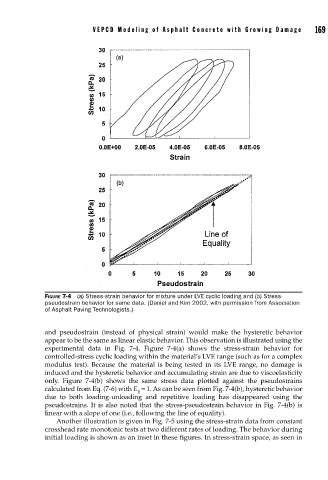
                    FIGURE 7-4  (a) Stress-strain behavior for mixture under LVE cyclic loading and (b) Stress-
                    pseudostrain behavior for same data. (Daniel and Kim 2002, with permission from Association
                    of Asphalt Paving Technologists.)


                    and pseudostrain (instead of physical strain) would make the hysteretic behavior
                    appear to be the same as linear elastic behavior. This observation is illustrated using the
                    experimental data in Fig. 7-4. Figure 7-4(a) shows the stress-strain behavior for
                    controlled-stress cyclic loading within the material’s LVE range (such as for a complex
                    modulus test). Because the material is being tested in its LVE range, no damage is
                    induced and the hysteretic behavior and accumulating strain are due to viscoelasticity
                    only. Figure 7-4(b) shows the same stress data plotted against the pseudostrains
                    calculated from Eq. (7-6) with E = 1. As can be seen from Fig. 7-4(b), hysteretic behavior
                                              R
                    due to both loading-unloading and repetitive loading has disappeared using the
                    pseudostrains. It is also noted that the stress-pseudostrain behavior in Fig. 7-4(b) is
                    linear with a slope of one (i.e., following the line of equality).
                       Another illustration is given in Fig. 7-5 using the stress-strain data from constant
                    crosshead rate monotonic tests at two different rates of loading. The behavior during
                    initial loading is shown as an inset in these figures. In stress-strain space, as seen in

