


Page 196 - MODELING OF ASPHALT CONCRETE
P. 196
174    Cha pte r  Se v e n


                    quantified by a set of parameters often referred to as internal state variables or damage
                    parameters in the context of thermodynamics of irreversible processes. The growth of
                    damage is governed by an appropriate damage (or internal state) evolution law. The
                    stiffness of the material, which varies with the extent of damage, is determined as a
                    function of the internal state variables by fitting the theoretical model to available
                    experimental data.
                       The mechanical behavior of an elastic medium with constant material properties
                    (i.e., without damage growth) can usually be described using an appropriate
                    thermodynamic potential (e.g., the Helmholtz free energy for isothermal processes or the
                    Gibbs free energy for isentropic processes). These potentials are point functions of
                    thermodynamic state variables. When thermal effects are not considered, both the
                    Helmholtz free energy and the Gibbs free energy potentials are identified with the so-
                    called strain energy and represent the energy stored in the system which is algebraically
                    equal to the work done on the system by external loading. However, when damage occurs
                    due to external loading, the work done on the body is not entirely stored as strain energy;
                    part of it is consumed in causing damage to the body. The amount of energy required to
                    produce a given extent of damage is expressed as a function of internal state variables. The
                    total work input to the body during the processes in which damage occurs depends, in
                    general, on the path of loading. However, it has been observed that, for certain processes
                    in which damage occurs, the work input is independent of the path of loading (Schapery
                    1987a; Lamborn and Schapery 1988, 1993).
                       Schapery (1990) applied the method of thermodynamics of irreversible processes
                    and the observed phenomenon of path independence of work in damage-inducing
                    processes to develop the work potential theory so that it may be applicable to describing
                    the mechanical behavior of elastic media with growing damage and other structural
                    changes. The theory is general enough to allow for strong nonlinearities and coupling
                    between the internal state variables and to describe a variety of mechanisms including
                    micro- and macrocrack growth in monolithic and composite materials. Sicking (1992)
                    applied the theory to model the damage-related material nonlinearity in graphite-epoxy
                    laminates, and Lamborn and Schapery (1993) showed the existence of a work potential
                    for suitably limited deformation paths using experimental data from axial and torsional
                    deformation tests on angle-ply fiber-reinforced plastic laminates. The elements of work
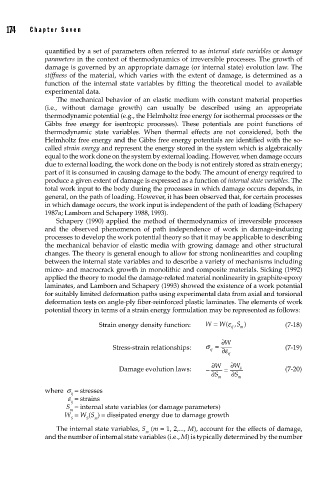
                    potential theory in terms of a strain energy formulation may be represented as follows:

                                   Strain energy density function:    W =  W(,ε ij  S )  (7-18)
                                                                           m
                                                                      ∂ W
                                       Stress-strain relationships:    σ =  ε ∂         (7-19)
                                                                   ij
                                                                        ij
                                                                   ∂W    ∂W
                                              Damage evolution laws:    −  =  S         (7-20)
                                                                   ∂S    ∂S
                                                                     m     m
                    where  s = stresses
                            ij
                           e = strains
                            ij
                          S = internal state variables (or damage parameters)
                           m
                          W = W (S ) = dissipated energy due to damage growth
                            S   S  m
                       The internal state variables, S  (m = 1, 2,..., M), account for the effects of damage,
                                                 m
                    and the number of internal state variables (i.e., M) is typically determined by the number

