


Page 199 - MODELING OF ASPHALT CONCRETE
P. 199
VEPCD Modeling of Asphalt Concr ete with Gr owing Damage      177


                       Substituting this expression into Eq. (7-24), and rearranging and writing in the
                    discrete form, one finds the following equation:

                                                        ⎛  (δ W )  ⎞ α                  (7-31)
                                                              R
                                                       t −
                                              S  =  S + Δ ⎜ ⎝  d  i  ⎟ ⎠
                                               i+1  i       δ S
                                                                                R
                       It must be observed that for the uniaxial case, the work function (W ) is given by
                                                  W =   1 C S()ε R                      (7-32)
                                                    R
                                                        2
                       Substituting Eq. (7-32) into (7-31) and simplifying, one arrives at
                                                      ⎛  1    (δ C ⎞ α
                                                                 )
                                                             )
                                            S  =  S + Δ t − (ε R 2  i  ⎟                (7-33)
                                                      ⎜
                                             i+1  i   ⎝  2     δ S ⎠
                       In Eq. (7-33), it is assumed that before loading occurs,  S and  C are zero and one,
                    respectively. Further, dS must be specified and should be significantly less than the change
                    in damage over a time step (typically, 0.1 is used). After calculating the value of damage
                    (S) and the incremental damage (S + dS) at a given time step, the corresponding values of
                      i                         i
                    C are found by Eq. (7-29). The difference between these values (dC) is then used to calculate
                    damage at the next time step. The process is repeated until all data points are processed.
                       After completing this first iteration, the new values of S are plotted against the
                    original pseudostiffness values, and a new analytical relationship is found. The entire
                    process is repeated until the change in successive iterations is small. In this research,
                    eight such iterations were performed, but it was noted that very little improvement was
                    made after the third or fourth iteration.
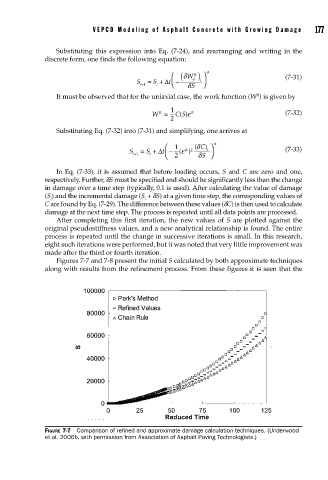
                       Figures 7-7 and 7-8 present the initial S calculated by both approximate techniques
                    along with results from the refinement process. From these figures it is seen that the


                    FIGURE 7-7  Comparison of refi ned and approximate damage calculation techniques. (Underwood
                    et al. 2006b, with permission from Association of Asphalt Paving Technologists.)

