


Page 197 - MODELING OF ASPHALT CONCRETE
P. 197
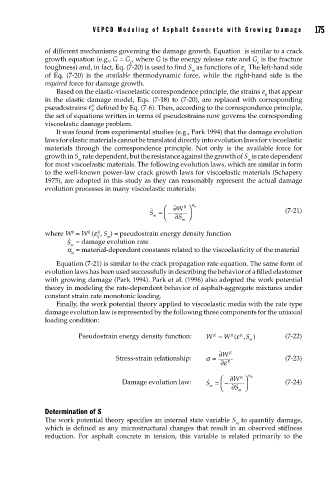
VEPCD Modeling of Asphalt Concr ete with Gr owing Damage      175


                    of different mechanisms governing the damage growth. Equation  is similar to a crack
                    growth equation (e.g., G = G , where G is the energy release rate and G  is the fracture
                                            c                                   c
                    toughness) and, in fact, Eq. (7-20) is used to find S  as functions of e  The left-hand side
                                                              m             ij.
                    of Eq. (7-20) is the  available thermodynamic force, while the right-hand side is the
                    required force for damage growth.
                       Based on the elastic-viscoelastic correspondence principle, the strains e  that appear
                                                                                  ij
                    in the elastic damage model, Eqs. (7-18) to (7-20), are replaced with corresponding
                                  R
                    pseudostrains ε  defined by Eq. (7-6). Then, according to the correspondence principle,
                                 ij
                    the set of equations written in terms of pseudostrains now governs the corresponding
                    viscoelastic damage problem.
                       It was found from experimental studies (e.g., Park 1994) that the damage evolution
                    laws for elastic materials cannot be translated directly into evolution laws for viscoelastic
                    materials through the correspondence principle. Not only is the available force for
                    growth in S  rate dependent, but the resistance against the growth of S  is rate dependent
                              m                                              m
                    for most viscoelastic materials. The following evolution laws, which are similar in form
                    to the well-known power-law crack growth laws for viscoelastic materials (Schapery
                    1975), are adopted in this study as they can reasonably represent the actual damage
                    evolution processes in many viscoelastic materials:

                                                      ⎛
                                                           R

                                                  S =−  ∂ ∂ W ⎞ ⎟ α m                   (7-21)
                                                      ⎜
                                                          S ⎠
                                                      ⎝
                                                   m
                                                           m
                                R
                            R
                    where W = W (ε , S ) = pseudostrain energy density function
                                   R
                                   ij
                                      m

                          S = damage evolution rate
                           m
                          a = material-dependent constants related to the viscoelasticity of the material
                            m
                       Equation (7-21) is similar to the crack propagation rate equation. The same form of
                    evolution laws has been used successfully in describing the behavior of a filled elastomer
                    with growing damage (Park 1994). Park et al. (1996) also adopted the work potential
                    theory in modeling the rate-dependent behavior of asphalt-aggregate mixtures under
                    constant strain rate monotonic loading.
                       Finally, the work potential theory applied to viscoelastic media with the rate type
                    damage evolution law is represented by the following three components for the uniaxial
                    loading condition:
                         Pseudostrain energy density function:   W =   W (ε R  S ,  )   (7-22)
                                                                         R
                                                                    R
                                                                              m
                                                                     ∂W  R
                                Stress-strain relationship:   σ =                       (7-23)
                                                                       ε ∂  R
                                                                      ⎛
                                                                           R

                                 Damage evolution law:   S =−           ∂ W ⎞ ⎟ α m     (7-24)
                                                                      ⎜
                                                                   m  ⎝  ∂ S ⎠
                                                                           m
                    Determination of S
                    The work potential theory specifies an internal state variable S  to quantify damage,
                                                                          m
                    which is defined as any microstructural changes that result in an observed stiffness
                    reduction. For asphalt concrete in tension, this variable is related primarily to the

