


Page 202 - MODELING OF ASPHALT CONCRETE
P. 202
180    Cha pte r  Se v e n


                       Replacing time in Eq. (7-42) with reduced time yields
                                                       1 p ⎛  ξ   1 p+1
                                                 ⎛  p + ⎞  +1    ⎞
                                                     1
                                            ε vp  =  ⎜ ⎝  Y ⎠ ⎟  ⎜ ∫ σ ξ d  ⎟           (7-42)
                                                              q
                                                          ⎝ 0    ⎠
                    Observe that the plastic strain is zero in this model because the viscoplastic strain
                    vanishes at x = 0. It was found that such simplicity does indeed exist in asphalt concrete
                    (Chehab et al. 2003).


               VEPCD Model
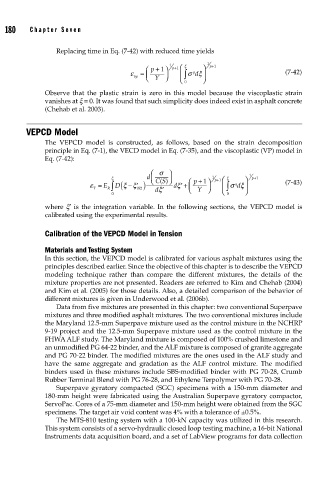
                    The VEPCD model is constructed, as follows, based on the strain decomposition
                    principle in Eq. (7-1), the VECD model in Eq. (7-35), and the viscoplastic (VP) model in
                    Eq. (7-42):

                                                  ⎛  σ ⎞
                                       ξ         d ⎜  CS ⎠ ⎟  ⎛  p + 1 ⎞  1 p +1  ⎛  ξ  ⎞  1  p +1
                                 ε =  E R∫ D( ξ ξ′ )  ⎝ ()  ξ d ′ +  ⎜ ⎜  ⎟  ⎜ ∫ σξ ⎟   (7-43)
                                            −
                                                                          d
                                                                          q
                                  T           182   ξ d ′    ⎝  Y ⎠          ⎠
                                       0                              ⎝ 0
                    where  x′ is the integration variable. In the following sections, the VEPCD model is
                    calibrated using the experimental results.
                    Calibration of the VEPCD Model in Tension
                    Materials and Testing System
                    In this section, the VEPCD model is calibrated for various asphalt mixtures using the
                    principles described earlier. Since the objective of this chapter is to describe the VEPCD
                    modeling technique rather than compare the different mixtures, the details of the
                    mixture properties are not presented. Readers are referred to Kim and Chehab (2004)
                    and Kim et al. (2005) for those details. Also, a detailed comparison of the behavior of
                    different mixtures is given in Underwood et al. (2006b).
                       Data from five mixtures are presented in this chapter: two conventional Superpave
                    mixtures and three modified asphalt mixtures. The two conventional mixtures include
                    the Maryland 12.5-mm Superpave mixture used as the control mixture in the NCHRP
                    9-19 project and the 12.5-mm Superpave mixture used as the control mixture in the
                    FHWA ALF study. The Maryland mixture is composed of 100% crushed limestone and
                    an unmodified PG 64-22 binder, and the ALF mixture is composed of granite aggregate
                    and PG 70-22 binder. The modified mixtures are the ones used in the ALF study and
                    have the same aggregate and gradation as the  ALF control mixture. The modified
                    binders used in these mixtures include SBS-modified binder with PG 70-28, Crumb
                    Rubber Terminal Blend with PG 76-28, and Ethylene Terpolymer with PG 70-28.
                       Superpave gyratory compacted (SGC) specimens with a 150-mm diameter and
                    180-mm height were fabricated using the Australian Superpave gyratory compactor,
                    ServoPac. Cores of a 75-mm diameter and 150-mm height were obtained from the SGC
                    specimens. The target air void content was 4% with a tolerance of ±0.5%.
                       The MTS-810 testing system with a 100-kN capacity was utilized in this research.
                    This system consists of a servo-hydraulic closed loop testing machine, a 16-bit National
                    Instruments data acquisition board, and a set of LabView programs for data collection

