


Page 204 - MODELING OF ASPHALT CONCRETE
P. 204
182    Cha pte r  Se v e n


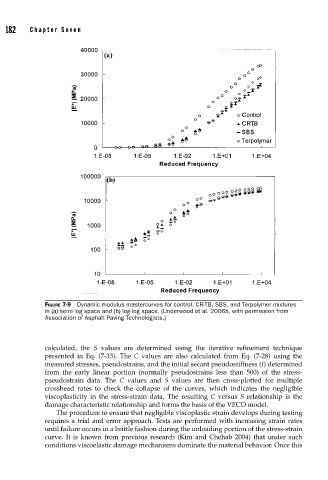
                    FIGURE 7-9  Dynamic modulus mastercurves for control, CR-TB, SBS, and Terpolymer mixtures
                    in (a) semi-log space and (b) log-log space. (Underwood et al. 2006b, with permission from
                    Association of Asphalt Paving Technologists.)


                    calculated, the  S values are determined using the iterative refinement technique
                    presented in Eq. (7-33). The  C values are also calculated from Eq. (7-28) using the
                    measured stresses, pseudostrains, and the initial secant pseudostiffness (I) determined
                    from the early linear portion (normally pseudostrains less than 500) of the stress-
                    pseudostrain data. The  C values and  S values are then cross-plotted for multiple
                    crosshead rates to check the collapse of the curves, which indicates the negligible
                    viscoplasticity in the stress-strain data. The resulting  C versus  S relationship is the
                    damage characteristic relationship and forms the basis of the VECD model.
                       The procedure to ensure that negligible viscoplastic strain develops during testing
                    requires a trial and error approach. Tests are performed with increasing strain rates
                    until failure occurs in a brittle fashion during the unloading portion of the stress-strain
                    curve. It is known from previous research (Kim and Chehab 2004) that under such
                    conditions viscoelastic damage mechanisms dominate the material behavior. Once this

