


Page 209 - MODELING OF ASPHALT CONCRETE
P. 209
VEPCD Modeling of Asphalt Concr ete with Gr owing Damage      187


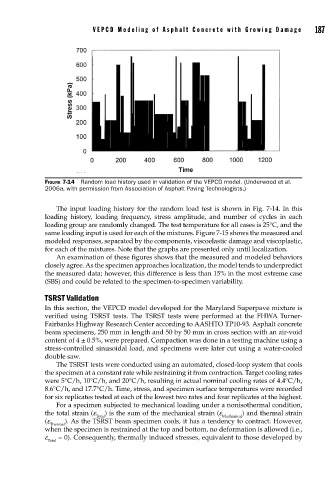
                    FIGURE 7-14  Random load history used in validation of the VEPCD model. (Underwood et al.
                    2006a, with permission from Association of Asphalt Paving Technologists.)

                       The input loading history for the random load test is shown in Fig. 7-14. In this
                    loading history, loading frequency, stress amplitude, and number of cycles in each
                    loading group are randomly changed. The test temperature for all cases is 25°C, and the
                    same loading input is used for each of the mixtures. Figure 7-15 shows the measured and
                    modeled responses, separated by the components, viscoelastic damage and viscoplastic,
                    for each of the mixtures. Note that the graphs are presented only until localization.
                       An examination of these figures shows that the measured and modeled behaviors
                    closely agree. As the specimen approaches localization, the model tends to underpredict
                    the measured data; however, this difference is less than 15% in the most extreme case
                    (SBS) and could be related to the specimen-to-specimen variability.

                    TSRST Validation
                    In this section, the VEPCD model developed for the Maryland Superpave mixture is
                    verified using TSRST tests. The TSRST tests were performed at the FHWA Turner-
                    Fairbanks Highway Research Center according to AASHTO TP10-93. Asphalt concrete
                    beam specimens, 250 mm in length and 50 by 50 mm in cross section with an air-void
                    content of 4 ± 0.5%, were prepared. Compaction was done in a testing machine using a
                    stress-controlled sinusoidal load, and specimens were later cut using a water-cooled
                    double saw.
                       The TSRST tests were conducted using an automated, closed-loop system that cools
                    the specimen at a constant rate while restraining it from contraction. Target cooling rates
                    were 5°C/h, 10°C/h, and 20°C/h, resulting in actual nominal cooling rates of 4.4°C/h,
                    8.6°C/h, and 17.7°C/h. Time, stress, and specimen surface temperatures were recorded
                    for six replicates tested at each of the lowest two rates and four replicates at the highest.
                       For a specimen subjected to mechanical loading under a nonisothermal condition,
                    the total strain (e  ) is the sum of the mechanical strain (e  ) and thermal strain
                                   Total                              Mechanical
                    (e    ). As the TSRST beam specimen cools, it has a tendency to contract. However,
                      Thermal
                    when the specimen is restrained at the top and bottom, no deformation is allowed (i.e.,
                    e   = 0). Consequently, thermally induced stresses, equivalent to those developed by
                     Total

