


Page 211 - MODELING OF ASPHALT CONCRETE
P. 211
VEPCD Modeling of Asphalt Concr ete with Gr owing Damage      189


                    Prediction of Thermal Stress History
                    For notational brevity, the thermal stress and strain are identified by s and e, respectively.
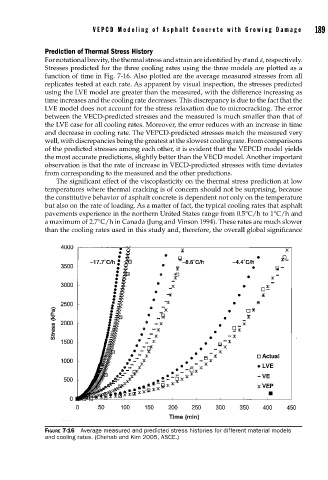
                    Stresses predicted for the three cooling rates using the three models are plotted as a
                    function of time in Fig. 7-16. Also plotted are the average measured stresses from all
                    replicates tested at each rate. As apparent by visual inspection, the stresses predicted
                    using the LVE model are greater than the measured, with the difference increasing as
                    time increases and the cooling rate decreases. This discrepancy is due to the fact that the
                    LVE model does not account for the stress relaxation due to microcracking. The error
                    between the VECD-predicted stresses and the measured is much smaller than that of
                    the LVE case for all cooling rates. Moreover, the error reduces with an increase in time
                    and decrease in cooling rate. The VEPCD-predicted stresses match the measured very
                    well, with discrepancies being the greatest at the slowest cooling rate. From comparisons
                    of the predicted stresses among each other, it is evident that the VEPCD model yields
                    the most accurate predictions, slightly better than the VECD model. Another important
                    observation is that the rate of increase in VECD-predicted stresses with time deviates
                    from corresponding to the measured and the other predictions.
                       The significant effect of the viscoplasticity on the thermal stress prediction at low
                    temperatures where thermal cracking is of concern should not be surprising, because
                    the constitutive behavior of asphalt concrete is dependent not only on the temperature
                    but also on the rate of loading. As a matter of fact, the typical cooling rates that asphalt
                    pavements experience in the northern United States range from 0.5°C/h to 1°C/h and
                    a maximum of 2.7°C/h in Canada (Jung and Vinson 1994). These rates are much slower
                    than the cooling rates used in this study and, therefore, the overall global significance


                    FIGURE 7-16  Average measured and predicted stress histories for different material models
                    and cooling rates. (Chehab and Kim 2005, ASCE.)

