


Page 210 - MODELING OF ASPHALT CONCRETE
P. 210
188    Cha pte r  Se v e n


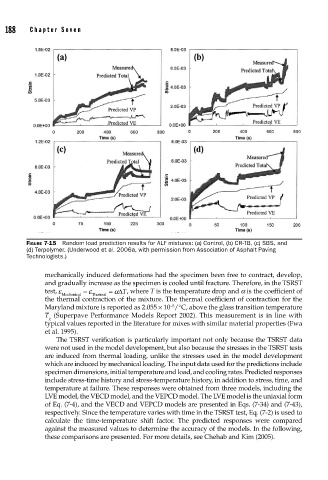
               FIGURE 7-15  Random load prediction results for ALF mixtures: (a) Control, (b) CR-TB, (c) SBS, and
               (d) Terpolymer. (Underwood et al. 2006a, with permission from Association of Asphalt Paving
               Technologists.)

                    mechanically induced deformations had the specimen been free to contract, develop,
                    and gradually increase as the specimen is cooled until fracture. Therefore, in the TSRST
                    test, ε    − ε    =  αΔT, where T is the temperature drop and a is the coefficient of
                         Mechanical  Thermal
                    the thermal contraction of the mixture. The thermal coefficient of contraction for the
                                                        −5
                    Maryland mixture is reported as 2.055 × 10 /°C, above the glass transition temperature
                    T  (Superpave Performance Models Report 2002). This measurement is in line with
                     g
                    typical values reported in the literature for mixes with similar material properties (Fwa
                    et al. 1995).
                       The TSRST verification is particularly important not only because the TSRST data
                    were not used in the model development, but also because the stresses in the TSRST tests
                    are induced from thermal loading, unlike the stresses used in the model development
                    which are induced by mechanical loading. The input data used for the predictions include
                    specimen dimensions, initial temperature and load, and cooling rates. Predicted responses
                    include stress-time history and stress-temperature history, in addition to stress, time, and
                    temperature at failure. These responses were obtained from three models, including the
                    LVE model, the VECD model, and the VEPCD model. The LVE model is the uniaxial form
                    of Eq. (7-4), and the VECD and VEPCD models are presented in Eqs. (7-34) and (7-43),
                    respectively. Since the temperature varies with time in the TSRST test, Eq. (7-2) is used to
                    calculate the time-temperature shift factor. The predicted responses were compared
                    against the measured values to determine the accuracy of the models. In the following,
                    these comparisons are presented. For more details, see Chehab and Kim (2005).

