


Page 201 - MODELING OF ASPHALT CONCRETE
P. 201
VEPCD Modeling of Asphalt Concr ete with Gr owing Damage      179


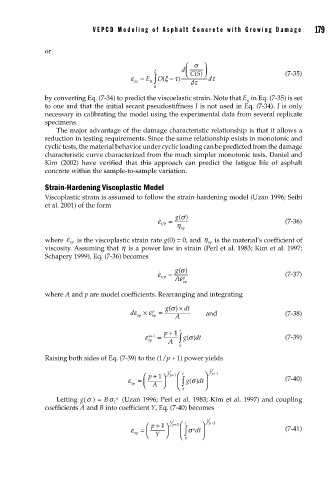
                    or
                                                            ⎛  σ ⎞
                                                   ξ       d ⎜  CS ⎠ ⎟
                                                       −
                                            ε =  E R∫  D( ξ τ)  ⎝ ()  τ d               (7-35)
                                             ve
                                                   0          τ d
                    by converting Eq. (7-34) to predict the viscoelastic strain. Note that E  in Eq. (7-35) is set
                                                                             R
                    to one and that the initial secant pseudostiffness I is not used in Eq. (7-34). I is only
                    necessary in calibrating the model using the experimental data from several replicate
                    specimens.
                       The major advantage of the damage characteristic relationship is that it allows a
                    reduction in testing requirements. Since the same relationship exists in monotonic and
                    cyclic tests, the material behavior under cyclic loading can be predicted from the damage
                    characteristic curve characterized from the much simpler monotonic tests. Daniel and
                    Kim (2002) have verified that this approach can predict the fatigue life of asphalt
                    concrete within the sample-to-sample variation.

                    Strain-Hardening Viscoplastic Model
                    Viscoplastic strain is assumed to follow the strain-hardening model (Uzan 1996; Seibi
                    et al. 2001) of the form
                                                           σ
                                                    	 ε  =  g()                         (7-36)
                                                     VP  η vp

                    where  ε  is the viscoplastic strain rate g(0) = 0, and  η  is the material’s coefficient of
                           vp
                                                                  vp
                    viscosity. Assuming that  η is a power law in strain (Perl et al. 1983; Kim et al. 1997;
                    Schapery 1999), Eq. (7-36) becomes
                                                          σ
                                                    	 ε  =  g()                         (7-37)
                                                     VP   ε p
                                                         A  vp
                    where A and p are model coefficients. Rearranging and integrating
                                                      g σ ×  dt
                                                       ()
                                            dε ×  ε p  =        and                     (7-38)
                                              vp  vp     A
                                                      p + 1  t
                                                ε p+1  =  ∫  g()                        (7-39)
                                                             σ dt
                                                 vp    A
                                                          0
                    Raising both sides of Eq. (7-39) to the (1/p + 1) power yields
                                                ⎛  p + ⎞  1 p ⎛  t  ⎞  1  p+1
                                                        +1
                                                    1
                                            ε  =  ⎜  ⎟    ⎜ ∫  g()  ⎟                   (7-40)
                                                              σ dt
                                             vp  ⎝  A ⎠          ⎠
                                                          ⎝ 0
                       Letting g(σ ) = Bσ 1 q  (Uzan 1996; Perl et al. 1983; Kim et al. 1997) and coupling
                    coefficients A and B into coefficient Y, Eq. (7-40) becomes
                                                                  1
                                                       1
                                                 ⎛  p + ⎞  p ⎛  t  ⎞  p+1
                                                         +1
                                                     1
                                            ε  =  ⎜   ⎟   ⎜ ∫ σ dt                      (7-41)
                                                              q
                                             vp  ⎝  Y ⎠         ⎟ ⎠
                                                          ⎝ 0

