


Page 186 - MODELING OF ASPHALT CONCRETE
P. 186
164    Cha pte r  Se v e n


                    evolution, plastic and viscoplastic flow of the binder, friction among aggregate particles,
                    and the coupling among these mechanisms. Additional difficulties arise from the fact
                    that the model must be able to account for the effects of rate of loading, loading time, rest
                    period, temperature, aging, and stress state so that the resulting model is applicable to a
                    range of loading and environmental conditions experienced in pavements.
                       This chapter presents a constitutive model that can describe the deformation behavior
                    of asphalt-aggregate mixtures under complex loading conditions at a wide range of
                    temperatures. The modeling strategy adopted is based on (1) the elastic and viscoelastic
                    behavior of asphalt concrete using the elastic-viscoelastic correspondence principle based
                    on pseudostrain, (2) the effect of microcracking on the constitutive behavior using
                    continuum damage mechanics, (3) the plastic and viscoplastic behavior using a time- and
                    stress-dependent viscoplastic model, and (4) the effect of temperature on the constitutive
                    behavior using the TTS principle with growing damage. The resulting models are integrated
                    by the strain decomposition approach to form the VEPCD model. The VEPCD model is
                    then validated under various loading and temperature conditions. Finally, the viscoelastic
                    continuum damage (VECD) model is implemented into the finite element program to
                    model the cracking behavior of asphalt pavements. Implementation of the full VEPCD
                    model into the finite element program is currently ongoing at North Carolina State
                    University.


               Analytical Framework
                    The analytical framework of the model presented in this chapter is based on the strain
                    decomposition principle suggested by Schapery (1999). In his work, Schapery demon-
                    strated that the total strain can be decomposed into viscoelastic strain and viscoplastic
                    strain, as follows:
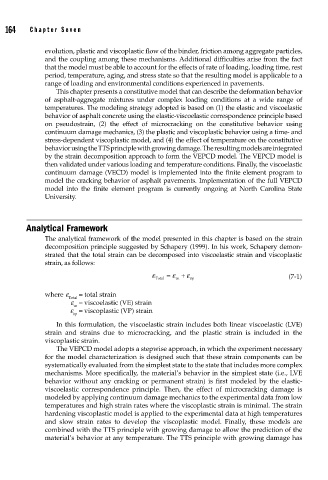
                                                  ε    =  ε +  ε                         (7-1)
                                                   Total  ve  vp
                    where e Total  = total strain
                            e = viscoelastic (VE) strain
                            ve
                           e = viscoplastic (VP) strain
                            vp
                       In this formulation, the viscoelastic strain includes both linear viscoelastic (LVE)
                    strain and strains due to microcracking, and the plastic strain is included in the
                    viscoplastic strain.
                       The VEPCD model adopts a stepwise approach, in which the experiment necessary
                    for the model characterization is designed such that these strain components can be
                    systematically evaluated from the simplest state to the state that includes more complex
                    mechanisms. More specifically, the material’s behavior in the simplest state (i.e., LVE
                    behavior without any cracking or permanent strain) is first modeled by the elastic-
                    viscoelastic correspondence principle. Then, the effect of microcracking damage is
                    modeled by applying continuum damage mechanics to the experimental data from low
                    temperatures and high strain rates where the viscoplastic strain is minimal. The strain
                    hardening viscoplastic model is applied to the experimental data at high temperatures
                    and slow strain rates to develop the viscoplastic model. Finally, these models are
                    combined with the TTS principle with growing damage to allow the prediction of the
                    material’s behavior at any temperature. The TTS principle with growing damage has

