


Page 229 - Modern Derivatization Methods for Separation Sciences
P. 229
Document                                                                                Página 1 de 1


                                                                                                         Page 104


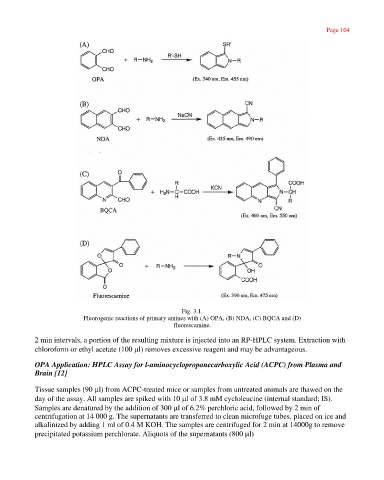
                                                           Fig. 3.1.
                            Fluorogenic reactions of primary amines with (A) OPA, (B) NDA, (C) BQCA and (D)
                                                        fluorescamine.

            2 min intervals, a portion of the resulting mixture is injected into an RP-HPLC system. Extraction with
            chloroform or ethyl acetate (100 µl) removes excessive reagent and may be advantageous.


            OPA Application: HPLC Assay for l-aminocyclopropanecarboxylic Acid (ACPC) from Plasma and
            Brain [12]

            Tissue samples (90 µl) from ACPC-treated mice or samples from untreated animals are thawed on the
            day of the assay. All samples are spiked with 10 µl of 3.8 mM cycloleucine (internal standard; IS).
            Samples are denatured by the addition of 300 µl of 6.2% perchloric acid, followed by 2 min of
            centrifugation at 14 000 g. The supernatants are transferred to clean microfuge tubes, placed on ice and
            alkalinized by adding 1 ml of 0.4 M KOH. The samples are centrifuged for 2 min at 14000g to remove
            precipitated potassium perchlorate. Aliquots of the supernatants (800 µl)


            http://emedia.netlibrary.com/nlreader/nlreader.dll?bookid=17968&filename=Page_104.ht...   30/09/2003

