


Page 234 - Modern Derivatization Methods for Separation Sciences
P. 234
Document                                                                                Página 1 de 2


                                                                                                         Page 107


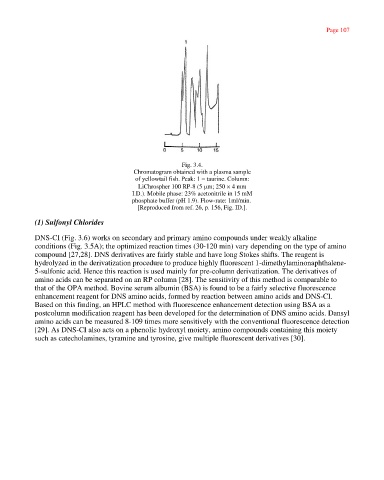
                                                           Fig. 3.4.
                                            Chromatogram obtained with a plasma sample
                                            of yellowtail fish. Peak: 1 = taurine. Column:
                                             LiChrospher 100 RP-8 (5 µm; 250 × 4 mm
                                           I.D.). Mobile phase: 23% acetonitrile in 15 mM
                                           phosphate buffer (pH 1.9). Flow-rate: 1ml/min.
                                             [Reproduced from ref. 26, p. 156, Fig. ID.].

            (1) Sulfonyl Chlorides

            DNS-CI (Fig. 3.6) works on secondary and primary amino compounds under weakly alkaline
            conditions (Fig. 3.5A); the optimized reaction times (30-120 min) vary depending on the type of amino
            compound [27,28]. DNS derivatives are fairly stable and have long Stokes shifts. The reagent is
            hydrolyzed in the derivatization procedure to produce highly fluorescent 1-dimethylaminonaphthalene-
            5-sulfonic acid. Hence this reaction is used mainly for pre-column derivatization. The derivatives of
            amino acids can be separated on an RP column [28]. The sensitivity of this method is comparable to
            that of the OPA method. Bovine serum albumin (BSA) is found to be a fairly selective fluorescence
            enhancement reagent for DNS amino acids, formed by reaction between amino acids and DNS-CI.
            Based on this finding, an HPLC method with fluorescence enhancement detection using BSA as a
            postcolumn modification reagent has been developed for the determination of DNS amino acids. Dansyl
            amino acids can be measured 8-109 times more sensitively with the conventional fluorescence detection
            [29]. As DNS-CI also acts on a phenolic hydroxyl moiety, amino compounds containing this moiety
            such as catecholamines, tyramine and tyrosine, give multiple fluorescent derivatives [30].


            http://emedia.netlibrary.com/nlreader/nlreader.dll?bookid=17968&filename=Page_107.ht...   30/09/2003

