


Page 232 - Modern Derivatization Methods for Separation Sciences
P. 232
Document                                                                                Página 1 de 2


                                                                                                         Page 106


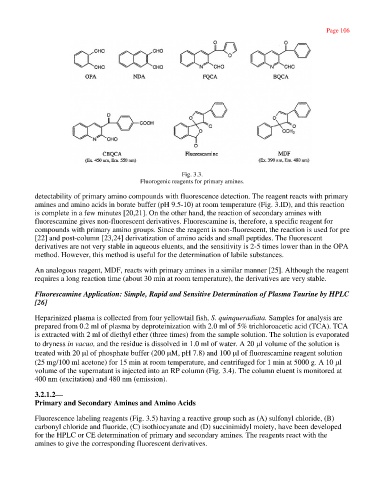
                                                           Fig. 3.3.
                                              Fluorogenic reagents for primary amines.

            detectability of primary amino compounds with fluorescence detection. The reagent reacts with primary
            amines and amino acids in borate buffer (pH 9.5-10) at room temperature (Fig. 3.ID), and this reaction
            is complete in a few minutes [20,21]. On the other hand, the reaction of secondary amines with
            fluorescamine gives non-fluorescent derivatives. Fluorescamine is, therefore, a specific reagent for
            compounds with primary amino groups. Since the reagent is non-fluorescent, the reaction is used for pre
            [22] and post-column [23,24] derivatization of amino acids and small peptides. The fluorescent
            derivatives are not very stable in aqueous eluents, and the sensitivity is 2-5 times lower than in the OPA
            method. However, this method is useful for the determination of labile substances.

            An analogous reagent, MDF, reacts with primary amines in a similar manner [25]. Although the reagent
            requires a long reaction time (about 30 min at room temperature), the derivatives are very stable.


            Fluorescamine Application: Simple, Rapid and Sensitive Determination of Plasma Taurine by HPLC
            [26]

            Heparinized plasma is collected from four yellowtail fish, S. quinqueradiata. Samples for analysis are
            prepared from 0.2 ml of plasma by deproteinization with 2.0 ml of 5% trichloroacetic acid (TCA). TCA
            is extracted with 2 ml of diethyl ether (three times) from the sample solution. The solution is evaporated
            to dryness in vacuo, and the residue is dissolved in 1.0 ml of water. A 20 µl volume of the solution is
            treated with 20 µl of phosphate buffer (200 µM, pH 7.8) and 100 µl of fluorescamine reagent solution
            (25 mg/100 ml acetone) for 15 min at room temperature, and centrifuged for 1 min at 5000 g. A 10 µl
            volume of the supernatant is injected into an RP column (Fig. 3.4). The column eluent is monitored at
            400 nm (excitation) and 480 nm (emission).


            3.2.1.2—
            Primary and Secondary Amines and Amino Acids

            Fluorescence labeling reagents (Fig. 3.5) having a reactive group such as (A) sulfonyl chloride, (B)
            carbonyl chloride and fluoride, (C) isothiocyanate and (D) succinimidyl moiety, have been developed
            for the HPLC or CE determination of primary and secondary amines. The reagents react with the
            amines to give the corresponding fluorescent derivatives.


            http://emedia.netlibrary.com/nlreader/nlreader.dll?bookid=17968&filename=Page_106.ht...   30/09/2003

