


Page 230 - Modern Derivatization Methods for Separation Sciences
P. 230
Document                                                                                Página 1 de 2


                                                                                                         Page 105


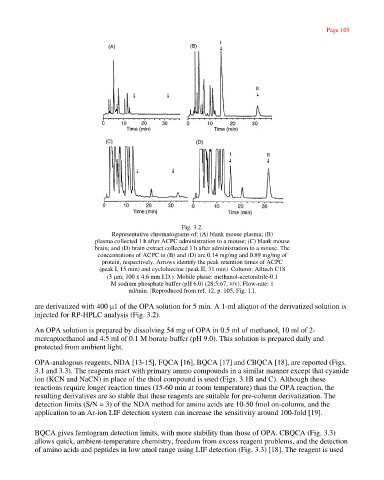
                                                           Fig. 3.2.
                                     Representative chromatograms of: (A) blank mouse plasma; (B)
                               plasma collected 1 h after ACPC administration to a mouse; (C) blank mouse
                               brain; and (D) brain extract collected 1 h after administration to a mouse. The
                                concentrations of ACPC in (B) and (D) are 0.14 mg/mg and 0.89 mg/mg of
                                 protein, respectively. Arrows identify the peak retention times of ACPC
                                 (peak I, 15 min) and cycloluecine (peak II, 31 min). Column: Alltech C18
                                   (3 µm; 100 x 4.6 mm I.D.). Mobile phase: methanol-acetonitrile-0.1
                                    M sodium phosphate buffer (pH 6.0) (28:5:67, v/v). Flow-rate: 1
                                          ml/min. [Reproduced from ref. 12, p. 105, Fig. 1.].

            are derivatized with 400 µ1 of the OPA solution for 5 min. A 1-ml aliquot of the derivatized solution is
            injected for RP-HPLC analysis (Fig. 3.2).

            An OPA solution is prepared by dissolving 54 mg of OPA in 0.5 ml of methanol, 10 ml of 2-
            mercaptoethanol and 4.5 ml of 0.1 M borate buffer (pH 9.0). This solution is prepared daily and
            protected from ambient light.

            OPA-analogous reagents, NDA [13-15], FQCA [16], BQCA [17] and CBQCA [18], are reported (Figs.
            3.1 and 3.3). The reagents react with primary ammo compounds in a similar manner except that cyanide
            ion (KCN and NaCN) in place of the thiol compound is used (Figs. 3.1B and C). Although these
            reactions require longer reaction times (15-60 min at room temperature) than the OPA reaction, the
            resulting derivatives are so stable that these reagents are suitable for pre-column derivatization. The
            detection limits (S/N = 3) of the NDA method for amino acids are 10-50 fmol on-column, and the
            application to an Ar-ion LIF detection system can increase the sensitivity around 100-fold [19].


            BQCA gives femtogram detection limits, with more stability than those of OPA. CBQCA (Fig. 3.3)
            allows quick, ambient-temperature chemistry, freedom from excess reagent problems, and the detection
            of amino acids and peptides in low amol range using LIF detection (Fig. 3.3) [18]. The reagent is used


            http://emedia.netlibrary.com/nlreader/nlreader.dll?bookid=17968&filename=Page_105.ht...   30/09/2003

