


Page 148 - Modern physical chemistry
P. 148
References                              139

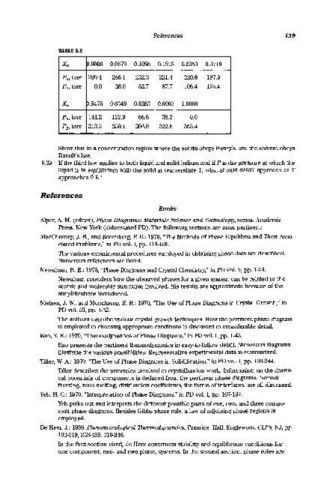
                   TABLE 6.E

                    X B    ~>.OOOO  0.0579   0.1095   0.1918  0.2353   0.3718
                    P A ,  torr  280.4   266.1   252.3   231.4   220.8   187.9
                    PB' torr   0.0   28.0   52.7   87.7   105.4   155.4

                    X B    p.5478   0.6349   0.8253   0.9093   1.0000
                    PM torr  144.2   122.9   66.6   38.2   0.0
                    PB' torr  213.3   239.1   296.9   322.5   353.4


                   Show that in a concentration region where the solute obeys Henry's law, the solvent obeys
                   Raoult's law.
              6.29  If the third law applies to both liquid and solid helium and if P is the pressure at which the
                   liquid is in equilibrium with the solid at temperature T,  what should dP/dT approach as T
                   approaches 0 K?

             References
                                                 Books

             Alper, A.  M.  (editor), Phase Diagrams: Materials Science and Technology, series, Academic
                   Press, New York (abbreviated PD). The following sections are most pertinent:
             MacChesney, J. B., and Rosenberg, P. E.:  1970, "The Methods of Phase Equilibria and Their Asso-
                   ciated Problems," in PD vol. I, pp.  113-165.
                   The various experimental procedures employed in obtaining phase data are described.
                   Numerous references are listed.
             Newnham, R  E.:  1978, "Phase Diagrams and Crystal Chemistry," in PD vol. V,  pp.  1-73.
                   Newnham considers how the observed phases for a given system can be related to the
                  atomic and molecular structures involved. His results are approximate because of the
                  simplifications introduced.
             Nielsen, J. W.,  and Monchamp, R  R: 1970, "The Use of Phase Diagrams in Crystal Growth," in
                   PD vol. III, pp. 1-52.
                  The authors describe various crystal growth techniques. How the pertinent phase diagram
                  is employed in choosing appropriate conditions is discussed in considerable detail.
             Rao, Y.  K.:  1970, "Thermodynamics of Phase Diagrams," in PD vol. I,  pp. 1-43.
                   Rao presents the pertinent thermodynamics in easy-to-follow detail. Numerous diagrams
                  illustrate the various possibilities. Representative experimental data is summarized.
             Tiller, W. A.:  1970, "The Use of Phase Diagrams in Solidification," in PD vol. I, pp. 199-244.
                  Tiller describes the principles involved in crystallization work. Information on the chemi-
                   cal potentials of components is deduced from the pertinent phase diagrams. Normal
                  freezing, zone melting, distribution coefficients, the forms of interfaces, are all discussed.
             Yeh, H.  C.:  1970, "Interpretation of Phase Diagrams," in PD vol. I,  pp. 167-197.
                  Yeh picks out and interprets the different possible parts of one, two, and three compo-
                  nent phase diagrams. Besides Gibbs phase rule, a law of adjoining phase regions is
                  employed.
             De Heer, J.:  1986, Phenomenological Thermodynamics, Prentice- Hall, Englewood Cliffs, NJ, pp.
                   192-219, 253-285, 310-346.
                  In the first section cited, de Heer constructs stability and equilibrium conditions for
                  one-component, one- and two-phase, systems. In the second section, phase rules are

