


Page 143 - Modern physical chemistry
P. 143
134                        Relationships between Phases

                The movement of a  constituent through a membrane impermeable to other con-
             stituents is called osmosis. In each case, the flow proceeds until the tendency for the
             constituent to leave one side balances the tendency for it to leave the other side.
                A difference in concentration of the mobile constituent can be maintained by apply-
             ing an excess pressure on the low concentration side.

             6.16 Osmotic Pressure
                Molecules tend to move from a region where their concentration is high to a region
             where their concentration is lower. When pure A is separated from a solution of B in A by
             a barrier permeable only to A,  a net movement of A molecules into the solution tends to
             occur. If the solution is confined, the pressure on it rises M' above that on the solvent. The
             excess pressure when equilibrium is reached is called the osmotic pressure of the solution.
                The tendency for a substance to leave a phase is measured by its vapor pressure above
             the phase. But this vapor pressure is raised by the excess total pressure on the phase. In
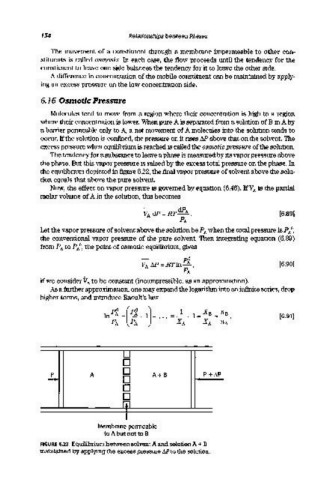
             the equilibrium depicted in figure 6.22, the final vapor pressure of solvent above the solu-
             tion equals that above the pure solvent.
                Now, the effect on vapor pressure is governed by equation (6.46). If VA is the partial
             molar volume of A in the solution, this becomes

                                            VA  dP=RT  dPA  .                        [6.89]
                                                       P A
             Let the vapor pressure of solvent above the solution be P A when the total pressure is P AO,
             the conventional vapor pressure of the pure solvent. Then integrating equation (6.89)
             from P A to p A O,  the point of osmotic equilibrium, gives
                                            -           Pg
                                           VAM'=RTln-,                               [6.90]
                                                        PA
             if we consider VA to be constant (incompressible, as an approximation).
                As a further approximation, one may expand the logarithm into an infinite series, drop
             higher tenns, and introduce Raoult's law:
                                  Pg
                                ln   =[pg -1)- ... =_1 __ 1= X= nB.                  [6.91]
                                                                B
                                  PA    PA            X A     X A  nA


                                      l5


                            A         D        A+B            p+~p
                                      D
                                      D
                                      D
                                      m

                                       I
                              Membrane permeable
                                to A but not to B
             FIGURE 6.22  Equilibrium between solvent A and solution A + B
             maintained by applying the excess pressure M  to the solution.

