


Page 142 - Modern physical chemistry
P. 142
6.15 Permeability of Membranes                  133

             where
                                                     2
                                             K  _RTo  MA                             [6.88]
                                               f  - 1000Lr

             Coefficient K f  is called the molal depression constant for the given solvent, R is the gas
             constant, To the freezing point of the pure solvent, !J.T the change in freezing point caused
             by addition of the solute, MA the molecular mass of the solvent, and L f the heat of fusion
             of the solvent per mole. Experimental depression constants for some common solvents
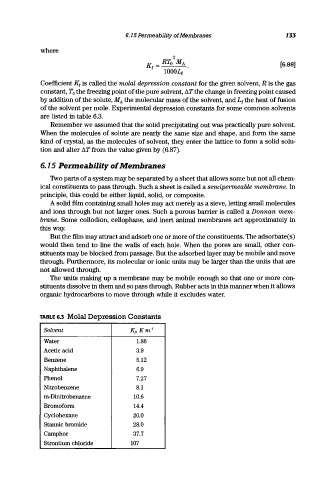
             are listed in table 6.3.
                Remember we assumed that the solid precipitating out was practically pure solvent.
             When the molecules of solute are nearly the same size and shape, and form the same
             kind of crystal, as the molecules of solvent, they enter the lattice to form a solid solu-
             tion and alter !J.T from the value given by (6.87).

             6.15 Permeability of Membranes

                Two parts of a system may be separated by a sheet that allows some but not all chem-
             ical constituents to pass through. Such a sheet is called a semipermeable membrane. In
             principle, this could be either liquid, solid, or composite.
                A solid film containing small holes may act merely as a sieve, letting small molecules
             and ions through but not larger ones. Such a porous barrier is called a Donnan mem-
             brane. Some collodion, cellophane, and inert animal membranes act approximately in
             this way.
                But the film may attract and adsorb one or more of the constituents. The adsorbate(s)
             would then tend to line the walls of each hole.  When the pores are small,  other con-
             stituents may be blocked from passage. But the adsorbed layer may be mobile and move
             through. Furthermore, its molecular or ionic units may be larger than the units that are
             not allowed through.
                The units making up a membrane may be mobile enough so that one or more con-
             stituents dissolve in them and so pass through. Rubber acts in this manner when it allows
             organic hydrocarbons to move through while it excludes water.


             TABLE 6.3  Molal Depression Constants

              Solvent                   Kft Km- 1
              Water                       1.86
              Acetic acid                 3.9
              Benzene                     5.12
              Naphthalene                 6.9
              Phenol                      7.27
              Nitrobenzene                8.1
              m-Dinitrobenzene           10.6
              Bromoform                  14.4
              Cyclohexane                20.0
              Stannic bromide            28.0
              Camphor                    37.7
              Strontium chloride        107

