


Page 137 - Modern physical chemistry
P. 137
128                       Relationships between Phases

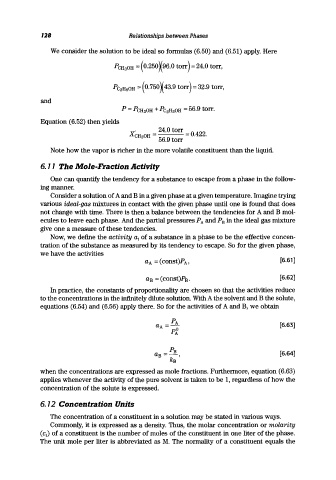
                We consider the solution to be ideal so formulas (6.50) and (6.51) apply. Here

                                   PCH30H = (0.250 X 96.0 torr) = 24.0 torr,


                                   PC2H50H = (0.750 X 43.9 torr) = 32.9 torr,
             and


             Equation (6.52) then yields
                                        x'     - 24.0 torr - 0 422
                                         CH30H  - 56 9   -.  .
                                                   .  torr
                Note how the vapor is richer in the more volatile constituent than the liquid.
             6.11  The Mole-Fraction Activity

                One can quantify the tendency for a substance to escape from a phase in the follow-
             ingmanner.
                Consider a solution of A and B in a given phase at a given temperature. hnagine trying
             various ideal-gas mixtures in contact with the given phase until one is found that does
             not change with time. There is then a balance between the tendencies for A and B mol-
             ecules to leave each phase. And the partial pressures P A and P B in the ideal gas mixture
             give one a measure of these tendencies.
                Now, we define the activity a j  of a substance in a phase to be the effective concen-
             tration of the substance as measured by its tendency to escape. So for the given phase,
             we have the activities
                                                                                     [6.61 ]


                                             aB = (const)PB •                        [6.62]
                In practice, the constants of proportionality are chosen so that the activities reduce
             to the concentrations in the infinitely dilute solution. With A the solvent and B the solute,
             equations (6.54) and (6.56) apply there. So for the activities of A and B, we obtain

                                                                                     [6.63]


                                                    PB
                                               aB=-,                                 [6.64]
                                                    kB
             when the concentrations are expressed as mole fractions. Furthermore, equation (6.63)
             applies whenever the activity of the pure solvent is taken to be 1, regardless of how the
             concentration of the solute is expressed.

             6. 12  Concentration Units
                The concentration of a constituent in a solution may be stated in various ways.
                Commonly, it is expressed as a density. Thus, the molar concentration or molarity
             (c i )  of a constituent is the number of moles of the constituent in one liter of the phase.
             The unit mole per liter is abbreviated as M.  The normality of a constituent equals the

