


Page 133 - Modern physical chemistry
P. 133
124                        Relationships between Phases

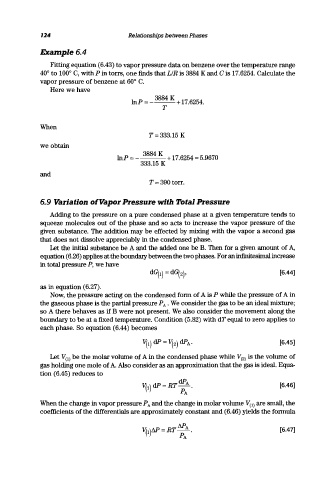
             Example 6.4

                Fitting equation (6.43) to vapor pressure data on benzene over the temperature range
             40° to 100° C, with P in torrs, one finds that LIR is 3884 K and Cis 17.6254. Calculate the
             vapor pressure of benzene at 60° C.
                Here we have
                                         lnP =  3884 K + 17.6254.
                                                  T

             When
                                              T=333.15 K
             we obtain

                                    lnP = _  3884 K  + 17.6254 = 5.9670
                                           333.15 K
             and
                                              T=390toIT.

             6.9 Variation of Vapor Pressure with Total Pressure

                Adding to the pressure on a pure condensed phase at a given temperature tends to
             squeeze molecules out of the phase and so acts to increase the vapor pressure of the
             given substance. The addition may be effected by mixing with the vapor a second gas
             that does not dissolve appreciably in the condensed phase.
                Let the initial substance be A and the added one be B. Then for a given amount of A,
             equation (6.26) applies at the boundary between the two phases. For an infinitesimal increase
             in total pressure P, we have
                                                                                     [6.44]

             as in equation (6.27).
                Now, the pressure acting on the condensed form of A is P while the pressure of A in
             the gaseous phase is the partial pressure P A  • We consider the gas to be an ideal mixture;
             so A there behaves as if B were not present. We also consider the movement along the
             boundary to be at a fixed temperature. Condition (5.82) with dT equal to zero applies to
             each phase. So equation (6.44) becomes

                                                                                     [6.45]
                Let VCl) be the molar volume of A in the condensed phase while V(2) is the volume of
             gas holding one mole of A. Also consider as an approximation that the gas is ideal. Equa-
             tion (6.45) reduces to
                                                       dP A
                                            "(1) dP = RT P .                         [6.46]
                                                        A
             When the change in vapor pressure P A and the change in molar volume VCl) are small, the
             coefficients of the differentials are approximately constant and (6.46) yields the formula


                                                                                     [6.47]

