


Page 135 - Modern physical chemistry
P. 135
126                       Relationships between Phases

             then holds. Similarly for constituent B, we have

                                              P B =x BP3,                            [6.51]
             where X B is the mole fraction of B in the condensed phase while P B  is the partial pres-
             sure of B in the gas phase and p B is the vapor pressure of pure B at the given tempera-
                                          Q
             ture. When equations (6.50) and (6.51) hold at all concentrations, the solution is said to
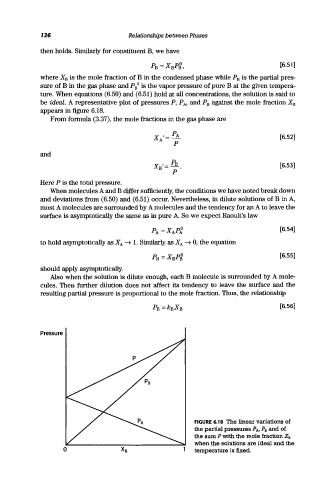
             be ideal. A representative plot of pressures P, PA'  and P B  against the mole fraction X B
             appears in figure 6.18.
                From formula (3.37), the mole fractions in the gas phase are
                                                  ,_PA
                                               X  A--                                [6.52]
                                                     P
             and

                                               X B '=  P B •                         [6.53]
                                                     P
             Here P is the total pressure.
                When molecules A and B differ sufficiently, the conditions we have noted break down
             and deviations from (6.50) and (6.51) occur. Nevertheless, in dilute solutions of B in A,
             most A molecules are surrounded by A molecules and the tendency for an A to leave the
             surface is asymptotically the same as in pure A  So we expect Raoult's law

                                               PA  =xAP1                             [6.54]
             to hold asymptotically as X A  --t 1. Similarly as X A  --t 0, the equation

                                               PB =xBP3                              [6.55]
             should apply asymptotically.
                Also when the solution is dilute enough, each B molecule is surrounded by A mole-
             cules.  Then further dilution does not affect its tendency to leave the surface and the
             resulting partial pressure is proportional to the mole fraction. Thus, the relationship

                                                                                     [6.56]


             Pressure


                                                           FIGURE 6.18  The linear variations of
                                                           the partial pressures PAl P B and of
                                                           the sum P with the mole fraction X B
                                                           when the solutions are ideal and the
                                                           temperature is fixed.

