


Page 139 - Modern physical chemistry
P. 139
130                        Relationships between Phases

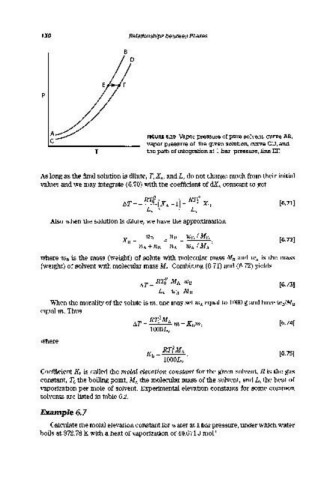
                                      B


              p


                A                            FIGURE 6.20  Vapor pressure of pure solvent, curve AB,
                C                            vapor pressure of  the given solution, curve CD, and
                              T              the path of integration at I bar  pressure, line EF.


             As long as the final solution is dilute, T, XA>  and Lv do not change much from their initial
             values and we may integrate (6.70) with the coefficient of dX A constant to get


                                      I!.T = - RTo2 (X A -1) = RTo2 X B'             [6.71 ]
                                             Lv           Lv
                Also when the solution is dilute, we have the approximation

                                      X =  nB     ~ _n_B = WB 1MB ,                  [6.72]
                                       B
                                           nA +nB   nA   WA I MA
             where Ws  is the mass (weight) of solute with molecular mass Ms  and W A  is the mass
             (weight) of solvent with molecular mass M A •  Combining (6.71) and (6.72) yields

                                           I!.T = RTo2  MA  WB  .                    [6.73]
                                                 Lv  WA  MB
                When the morality of the solute is m, one may set W A equal to 1000 g and have wslMs
             equal m. Thus
                                         I!.T =  RTo2 M A  m = K  m                  [6.74]
                                              1000L        b   ,
                                                   v
             where
                                             K  _ RTo2MA                             [6.75]
                                               b  - 1000L v

             Coefficient Kb is called the molal elevation constant for the given solvent, R is the gas
             constant, To  the boiling point, MA the molecular mass of the solvent, and Lv the heat of
             vaporization per mole of solvent. Experimental elevation constants for some common
             solvents are listed in table 6.2.
             Example 6.7

                Calculate the molal elevation constant for water at 1 bar pressure, under which water
             boils at 372.78 K with a heat of vaporization of 40,671 J mot l •

