


Page 144 - Modern physical chemistry
P. 144
6.17 Equilibria among Phases                   735

             For the final step, n B  is the number of moles of B, n A  the number of moles of A,  in the
             solution. If we also set
                                  nAV A =V'        when                              [6.92]

             formula (6.90) reduces to
                                               V'fJJ=RT.                             [6.93]
             Interestingly, this has the form of the ideal gas law. Here V'  is the volume of solvent
             containing one mole solute, fJJ is the osmotic pressure, R the gas constant, and T the
             temperature.

             Example 6.8

                Calculate the osmotic pressure for a 0.100 m sucrose solution at 30° C.
                The weight of solvent containing one mole solute is


                                    W  =  1000 g kg- l   = 10 000 g mo}"l
                                        0.100 mol kg-l  '          ,
             whence the corresponding solvent volume is

                                                     l
                                      V'= 10,000 gmol- =10 Imo}"l.
                                            1000 g 1-1
             Solve (6.93) for fJJ. Then substitute in the temperature and the solvent volume:
                                RT  (0.082061 atm K- mOl-lX303.2 K)
                                                    l
                           fJJ = -  =                              = 2.49 atm
                                V'              10 I mol- l
             If the pressure on the pure solvent is 1.00 atm, then a pressure of 3.49 atm must be exerted
             on the 0.100 m sucrose solution to stop osmosis of water from a reservoir of pure water
             into the solution.

             6. 17 Equilibria among Phases
                Let us now summarize the conditions governing the equilibria among differing homo-
             geneous mixtures. We assume that the entire system is free from outside influences, par-
             ticularly heat and work So inequality (5.114) applies. In the inunediate neighborhood of
             equilibrium, the system exhibits a given entropy, volume, and energy.
                For simplicity, consider two uniform, composite phases separated by an interface. Start-
             ing from equilibrium, let us introduce a small fluctuation. During this, the internal energy
             of each phase changes following formula (5.94).  But for bookkeeping purposes, we add
             the numerical superscripts (1) and (2) to the symbols to identify the pertinent phase.
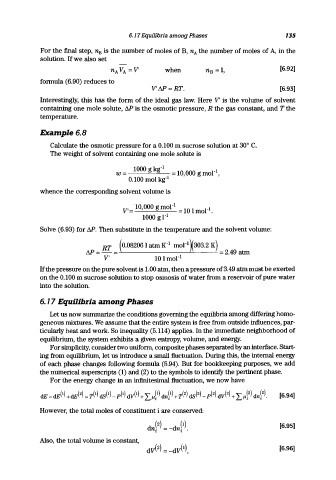
                For the energy change in an infinitesimal fluctuation, we now have


             However, the total moles of constituent i are conserved:

                                                                                     [6.95]

             Also, the total volume is constant,
                                                                                     [6.96]

