


Page 131 - Modern physical chemistry
P. 131
122                        Relationships between Phases

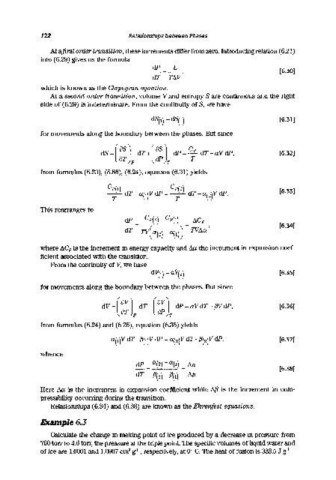
                At afirst order transition, these increments differ from zero. Introducing relation (6.21)
             into (6.29) gives us the formula
                                               dP    L                               [6.30]
                                               dT = T~V'

             which is known as the Clapeyron equation.
                At a second order transition, volume V and entropy S are continuous and the right
             side of (6.29) is indeterminate. From the continuity of S, we have

                                                                                     [6.31 ]
             for movements along the boundary between the phases. But since


                               dS=[as)  dT+[as)  dP = C dT-aV dP,                    [6.32]
                                                           p
                                     aT  p      ap  T     T
             from formulas (6.23), (5.86), (6.24), equation (6.31) yields

                                                                                     [6.33]

             This rearranges to
                                       dP   Cp(2) -Cp(l)   ~Cp
                                      dT = TV( a(2) -a(l)) = TV~a'                   [6.34]


             where ~Cp is the increment in energy capacity and ~a the increment in expansion coef-
             ficient associated with the transition.
                From the continuity of V, we have
                                                                                     [6.35]

             for movements along the boundary between the phases. But since

                                dV =(avJ  dT+(aVJ  dP = aV dT- f3V dP,               [6.36]
                                     aT  p      ap  T
             from formulas (6.24) and (6.25), equation (6.35) yields

                                  a(l)V dT -f3(1)V dP = a(2)V dT -f3(2)V dP,         [6.37]

             whence
                                          dP  a(2)-a(1)   ~a
                                          -=            =-                           [6.38]
                                          dT  13(2) - 13(1)   ~f3
             Here M  is the increment in expansion coefficient while M3  is the increment in com-
             pressibility occurring during the transition.
                Relationships (6.34) and (6.38) are known as the Ehrenjest equations.

             Example 6.3

                Calculate the change in melting point of ice produced by a decrease in pressure from
             760 torr to 4.6 torr, the pressure at the triple point. The specific volumes of liquid water and
             of ice are 1.0001 and 1.0907 cm 3  gl , respectively, at 0° C. The heat of fusion is 333.5 J gl .

