


Page 129 - Modern physical chemistry
P. 129
120                        Relationships between Phases

                  Q--------9

                 "
                                I  I  I
                               I
             d  ,  --~------o :
                   I  I
                              I
                                 I
                   I
               I   I   •      I   I
               I   I          I   I
              :  O------~-Q
              I'              I   I
              I   ,           I   I
              I   I           I  I
                              I  I
              I   I           .,
              ).('
             v---------Q
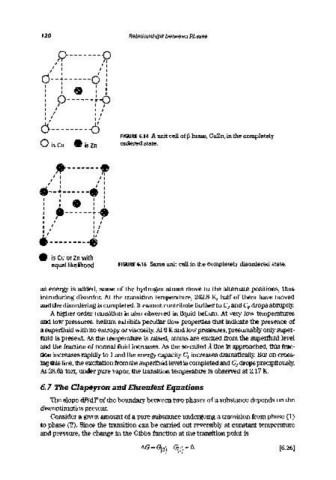
                                     FIGURE 6.14  A unit cell of /3  brass, CuZn, in the completely
             o isCu    •   isZn      ordered state.
                  &-------.
                  ,..",        II
               ,  "   I  I    I  I  I  I
             ..    I          I   I
              :  .------~ ...
             .--,,------.  I    I
                   I
                                I
                             I
                   I
                       •
              I
                   I
                                I
                             I
              I
              I'             I   I
              I   ,          I   I
              I   ,          I  I
              I  '
             J.t..'          I  I
                             .,
             W--------...
             •   is Cu or Zn with
                equal likelihood     FIGURE 6.15  Same unit cell in the completely disordered state.
             as energy is added, some of the hydrogen atoms move to the alternate positions, thus
             introducing disorder. At the transition temperature, 242.8  K,  half of them have moved
             and the disordering is completed. It cannot contribute further to Cp and Cp drops abruptly.
                A higher order transition is also observed in liquid helium. At very low temperatures
             and low pressures, helium exhibits peculiar flow properties that indicate the presence of
             a superfluid with no entropy or viscosity. At 0 K and low pressures, presumably only super-
             fluid is present. As the temperature is raised, atoms are excited from the superfluid level
             and the fraction of normal fluid increases. As the so-called A line is approached, this frac-
             tion increases rapidly to 1 and the energy capacity Cp increases dramatically. But on cross-
             ing this line, the excitation from the superfluid level is completed and C p drops precipitously.
             At 38.65 torr, under pure vapor, the transition temperature is observed at 2.17 K.

             6.7 The Clapeyron and Ehrenfest Equations
                The slope dP/dT of the boundary between two phases of a substance depends on the
             discontinuities present.
                Consider a given amount of a pure substance undergoing a transition from phase (1)
             to phase (2). Since the transition can be carried out reversibly at constant temperature
             and pressure, the change in the Gibbs function at the transition point is

                                                                                     [6.26]

