


Page 152 - Modern physical chemistry
P. 152
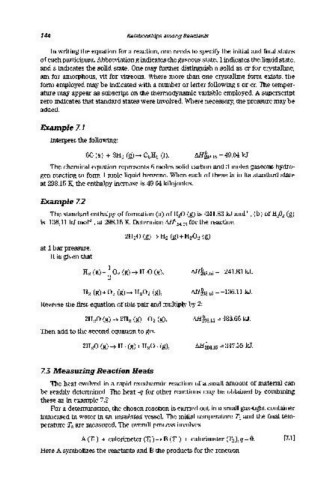
144                       Relationships among Reactants

                In writing the equation for a reaction, one needs to specify the initial and final states
             of each participant. Abbreviation g indicates the gaseous state, 1 indicates the liquid state,
             and s indicates the solid state. One may further distinguish a solid as cr for crystalline,
             am for amorphous, vit for vitreous.  Where more than one crystalline form exists, the
             form employed may be indicated with a number or letter following s or cr. The temper-
             ature may appear as subscript on the thermodynamic variable employed. A superscript
             zero indicates that standard states were involved. Where necessary, the pressure may be
             added.

             ExampleZl

                Interpret the following:
                                                            MI~98.15 = 49.04 kJ.
                The chemical equation represents 6 moles solid carbon and 3 moles gaseous hydro-
             gen reacting to form 1 mole liquid benzene. When each of these is in its standard state
             at 298.15 K,  the enthalpy increase is 49.04 kilojoules.

             ExampleZ2
                The standard enthalpy offormation (a) of H 20  (g) is -241.83 kJ moI-l , (b) of H20 2  (g)
             is -136,11 kJ moI-l , at 298.15 K. Determine Mfl 298 . 15  for the reaction


             at 1 bar pressure.
                It is given that

                                                          MI&8.15 = -241.83 kJ.


                                                          MI&8.15 = -136.11 kJ.
             Reverse the first equation of this pair and multiply by 2:

                          2H20  (g) ~ 2H2 (g) + O2 (g),    MI&8.15 = 483.66 kJ.
             Then add to the second equation to get

                                                            MI~98.15 = 347.55 kJ.


             Z3 Measuring Reaction Heats

                The heat evolved in a rapid exothermic reaction of a small amount of material can
             be readily determined. The heat -q  for other reactions may be obtained by combining
             these as in example 7.2.
                For a determination, the chosen reaction is carried out in a small gas-tight container
             immersed in water in an insulated vessel. The initial temperature TI and the final tem-
             perature T2  are measured. The overall process involves

                         A (11)  + calorimeter (11) ~ B (T 2 )  + calorimeter (T 2 ),q = O.   [7.1]
             Here A symbolizes the reactants and B the products for the reaction.

