


Page 153 - Modern physical chemistry
P. 153
7.4 Relating the Isobaric and Isochoric Reaction Heats   145

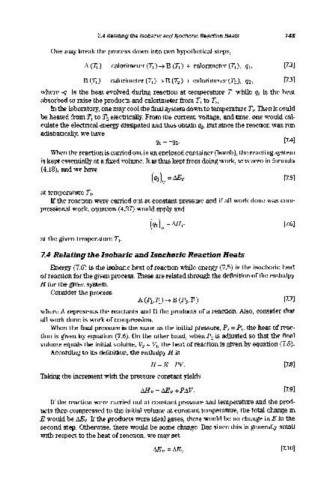
                One may break the process down into two hypothetical steps,

                          A (11)  + calorimeter (1l) ~ B (1i)  + calorimeter (Yi),  ql>   [7.2]
                          B(T l )  +  calorimeter(Tl)~B(T2) + calorimeter (T 2),  q2,   [7.3]
             where -ql is the heat evolved during reaction at temperature  TI while  q2  is the heat
             absorbed to raise the products and calorimeter from TI to T2 ,
                In the laboratory, one may cool the final system down to temperature T I • Then it could
             be heated from TI to T2 electrically. From the current, voltage, and time, one would cal-
             culate the electrical energy dissipated and thus obtain q2' But since the reaction was run
             adiabatically, we have
                                                                                      [7.4]
                When the reaction is carried out in an enclosed container (bomb), the reacting system
             is kept essentially at a fixed volume. It is thus kept from doing work, W is zero in formula
             (4.13), and we have
                                                                                      [7.5]

             at temperature T I •
                If the reaction were carried out at constant pressure and if all work done was com-
             pressional work, equation (4.27) would apply and

                                                                                      [7.6]

             at the given temperature T I •

             Z4 Relating the Isobaric and Isochoric Reaction Heats
                Energy (7.6) is the isobaric heat of reaction while energy (7.5) is the isochoric heat
             of reaction for the given process. These are related through the definition of the enthalpy
             H for the given system.
                Consider the process
                                                                                      [7.7]

             where A represents the reactants and B the products of a reaction. Also, consider that
             all work done is work of compression.
                When the final pressure is the same as the initial pressure, P 2  = PI' the heat of reac-
             tion is given by equation (7.6). On the other hand, when P 2 is adjusted so that the final
             volume equals the initial volume, V 2  = VI' the heat of reaction is given by equation (7.5).
                According to its definition, the enthalpy His

                                              H=E+PV.                                 [7.8]
             Taking the increment with the pressure constant yields
                                                                                      [7.9]

                If the reaction were carried out at constant pressure and temperature and the prod-
             ucts then compressed to the initial volume at constant temperature, the total change in
             E would be Mv. If the products were ideal gases, there would be no change in E in the
             second step. Otherwise, there would be some change. But since this is generally small
             with respect to the heat of reaction, we may set
                                                                                     [7.10]

