


Page 225 - Modern physical chemistry
P. 225
218                             Electrochemistry

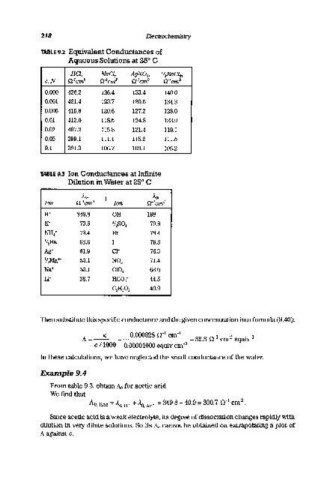
             TABLE 9.2  Equivalent Conductances of
                     Aqueous Solutions at 25° C

                      HCl,     NaCl,    AgNOI»   l/:eBaCl2>
              c,N    n- 1cm 2   n- 1cm 2   n- 1cm 2   n- 1cm 2

              0.000   426.2    126.4     133.4    140.0
              0.001   421.4    123.7     130.5    134.3
              0.005   415.8    120.6     127.2    128.0
              0.01   412.0     118.5     124.8    123.9
              0.02   407.2     115.8     121.4    119.1
              0.05   399.1     111.1     115.2    111.5
              0.1    391.3     106.7     109.1    105.2


             TABLE 9.3  Ion Conductances at Infinite
                     Dilution in Water at 25° C

                          AD>                  AD>
              Ion       n- 1cm 2   Ion       n- 1cm 2
              H+        349.8      OH-       198
              K+         73.5      1/2S0t     79.8
              NH 4 +     73.4      Br-        78.4
              1/2Ba++    63.6      1-         76.8
              Ag+        61.9      Cl-        76.3
              1/2Mg++    53.1      N0 3 -     71.4
              Na+        50.1      CI0 4 -    68.0
              Li+        38.7      HC0 3 -    44.5
                                   C 2 H 3 0 2 -  40.9


             Then substitute this specific conductance and the given concentration into formula (9.40):

                                                  1
                                                                           ·-1
                                        0.000828 n- cm -1
                                                                      2
                                                            82 8  n.-l
                          A =   1C    --------=  .              ~~  cm  equlv
                              c /1000   0.00001000 equiv cm-3
             In these calculations, we have neglected the small conductance of the water.
             Example 9.4
                From table 9.3, obtain 1\0 for acetic acid.
                We find that
                                                                          2
                                                                      1
                            Ao,  HAc  = 1.. 0 , W  + 1.. 0 , Ac- = 349.8 + 40.9 = 390.7 n- cm  •
                Since acetic acid is a weak electrolyte, its degree of dissociation changes rapidly with
             dilution in very dilute solutions. So its 1\0 cannot be obtained on extrapolating a plot of
             A against c.

