


Page 220 - Modern physical chemistry
P. 220
9.4 Moving Ion Clouds and Boundaries               213

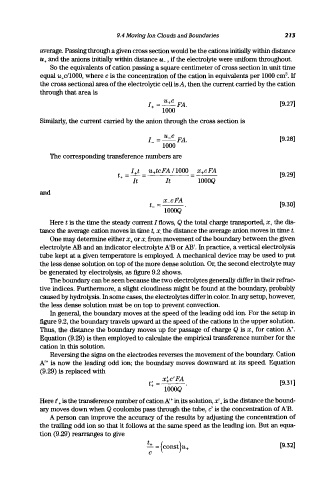
             average. Passing through a given cross section would be the cations initially within distance
             u+ and the anions initially within distance u_ , if the electrolyte were unifonn throughout.
                So the equivalents of cation passing a square centimeter of cross section in unit time
             equal u+clI000, where c is the concentration of the cation in equivalents per 1000 cm 3 • If
             the cross sectional area of the electrolytic cell is A, then the current carried by the cation
             through that area is
                                              I  =  U+c  FA.                         [9.27]
                                               +  1000
             Similarly, the current carried by the anion through the cross section is

                                              L  =  U_C  FA.                         [9.28]
                                                  1000
                The corresponding transference numbers are

                                                                                     [9.29]

             and

                                                                                     [9.30]
                                                  1000Q
                Here t is the time the steady current I flows, Q the total charge transported, x+ the dis-
             tance the average cation moves in time t, x. the distance the average anion moves in time t.
                One may determine either x+ or x. from movement of the boundary between the given
             electrolyte AB and an indicator electrolyte A'B or AB'. In practice, a vertical electrolysis
             tube kept at a given temperature is employed. A mechanical device may be used to put
             the less dense solution on top of the more dense solution. Or, the second electrolyte may
             be generated by electrolysis, as figure 9.2 shows.
                The boundary can be seen because the two electrolytes generally differ in their refrac-
             tive indices. Furthennore, a slight cloudiness might be found at the boundary, probably
             caused by hydrolysis. In some cases, the electrolytes differ in color. In any setup, however,
             the less dense solution must be on top to prevent convection.
                In general, the boundary moves at the speed of the leading odd ion. For the setup in
             figure 9.2, the boundary travels upward at the speed of the cations in the upper solution.
             Thus, the distance the boundary moves up for passage of charge Q is x+  for cation N.
             Equation (9.29) is then employed to calculate the empirical transference number for the
             cation in this solution.
                Reversing the signs on the electrodes reverses the movement of the boundary. Cation
             A'+  is now the leading odd ion; the boundary moves downward at its speed. Equation
             (9.29) is replaced with
                                                  x'c'FA
                                              t'  - ---'..+--                        [9.31 ]
                                              + -  1000Q
             Here t' + is the transference number of cation A'+ in its solution, x' + is the distance the bound-
             ary moves down when Q coulombs pass through the tube, c' is the concentration of A'B.
                A person can improve the accuracy of the results by adjusting the concentration of
             the trailing odd ion so that it follows at the same speed as the leading ion. But an equa-
             tion (9.29) rearranges to give
                                             !t. = ( const )u+                       [9.32]
                                              c

