


Page 218 - Modern physical chemistry
P. 218
9.3 Electrolyte Transference                  211

                In practice, the compartments may be separated by porous membranes. Or better,
             the electrolysis tube may be shaped to keep the contents of the compartments separate.
                For a run, electrolyte of known concentration is placed in the tube. Current is passed
             through for an interval of time and the number of faradays determined with a coulome-
             ter in series with the cell. About each electrode, all solution that differs from that in the
             middle compartment is removed and analyzed.  The  amount of electrolyte originally
             present in the water is calculated. The change in equivalents is then

                                                                                     [9.25]
             for each ion.
                For one ion and one compartment, the equivalents released at the electrode are Llne1ec_
             trolysis' The equivalents migrating are then
                                                                                     [9.26]
                                       Llnmigration = Lln - LlnelectrolysiS.
             The absolute value of Ll~tion divided by Llnelectrolysis equals the transference number of
             the ion.
                This method was developed by J. W. Hittorf. For accurate work, one should correct for
             the water transported with the ions. Alternatively, one may employ the moving boundary
             method discussed in section 9.4.  Or, the voltage of an electrolytic cell with transference
             can be compared to the same cell without transference.
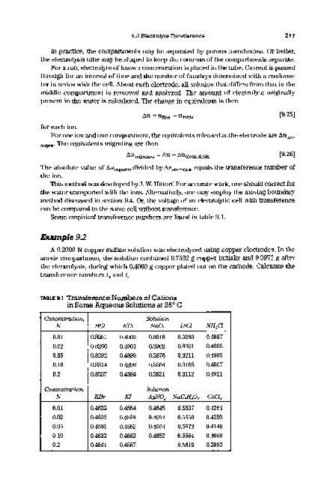
                Some empirical transference numbers are listed in table 9.1.


             ExampJe9.2
                A 0.2000 N copper sulfate solution was electrolyzed using copper electrodes. In the
             anode compartment, the solution contained 0.7532 g copper initially and 0.9972 g after
             the electrolysis, during which 0.4000 g copper plated out on the cathode. Calculate the
             transference numbers t+ and L


             TABLE 9.1  Transference Nwnbers of Cations
                     in Some Aqueous Solutions at 25 C
                                                     0
              Concentration,                 Solution
                  N          HCl      KCl     NaCl     LiCl    NH4Gl
                 0,01       0.8251   0.4902   0.3918   0.3289   0.4907
                 0.02       0.8266   0.4901   0.3902   0.3261   0.4906
                 0.05       0.8292   0.4899   0.3876   0.3211   0.4905
                 0.10       0.8314   0.4898   0.3854   0.3168   0.4907
                 0.2        0.8337   0.4894   0.3821   0.3112   0.4911
              Concentration,                 Solution
                  N          KBr      KI     AgN0 3   NaCtP30 2   CaGl2
                 0.01       0.4833   0.4884   0.4648   0.5537   0.4264
                 0.02       0.4832   0.4883   0.4652   0.5550   0.4220
                 0.05       0.4831   0.4882   0.4664   0.5573   0.4140
                 0.10       0.4833   0.4883   0.4682   0.5594   0.4060
                 0.2        0.4841   0.4887    -      0.5610   0.3953

