


Page 222 - Modern physical chemistry
P. 222
9.5 Ohm's Law                            215

             [, and if the average velocity at which they move is proportional to [, and to the perti-
             nent potential gradient, then the total current 1 is also proportional to [. We then have


                                              1=1[=&                                 [9.35]
                                                       R
             with conductance L and resistance R constant. When 1 is in amperes and e in volts, L is
             in mhos and R in ohms.
                Consider a uniform conductor of length l and cross sectional area A. Since voltages
             in series add, resistances in series add and the resistance of the conductor is propor-
             tional to its length. Since charges add, parallel currents add. So conductances in paral-
             lel add and the conductance of the conductor is proportional to its cross sectional area.
             Se have
                                                R=p~.                                [9.36]
                                                      A
             The constant of proportionality p is called the specific resistance. The reciprocal of the
             specific resistance is the specific conductance

                                                 1   lIA
                                             1\.=-=--.                               [9.37]
                                                 P    R
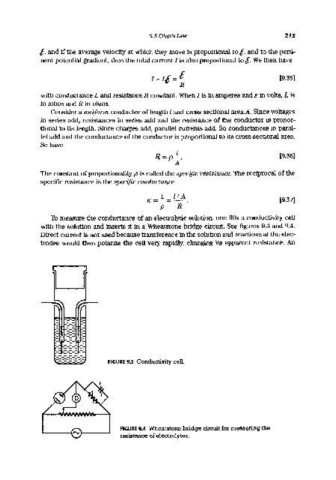
                To measure the conductance of an electrolytic solution, one fills a conductivity cell
             with the solution and inserts it in a Wheatstone bridge circuit. See figures 9.3 and 9.4.
             Direct current is not used because transference in the solution and reactions at the elec-
             trodes would then polarize the cell very rapidly,  changing its apparent resistance. An


                                 FIGURE 9.3  Conductivity cell.


                                     FIGURE 9.4  Wheatstone bridge circuit for measuring the
                                     resistance of electrolytes.

