


Page 224 - Modern physical chemistry
P. 224
9.6 Equivalent Conductance                     217

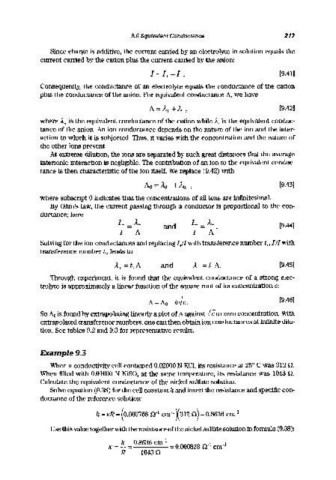
                Since charge is additive, the current carried by an electrolyte in solution equals the
             current carried by the cation plus the current carried by the anion:

                                                                                     [9.41 ]
             Consequently, the conductance of an electrolyte equals the conductance of the cation
             plus the conductance of the anion. For equivalent conductance A, we have

                                                                                     [9.42]
             where A+ is the equivalent conductance of the cation while A_  is the equivalent conduc-
             tance of the anion. An ion conductance depends on the nature of the ion and the inter-
             action to which it is subjected. Thus, it varies with the concentration and the nature of
             the other ions present.
                At extreme dilution, the ions are separated by such great distances that the average
             interionic interaction is negligible. The contribution of an ion to the equivalent conduc-
             tance is then characteristic of the ion itself. We replace (9.42) with

                                            Ao = ~,+ + ~,-,                          [9.43]
             where subscript 0 indicates that the concentrations of all ions are infinitesimal.
                By Ohm's law, the current passing through a conductor is proportional to the con-
             ductance; here
                                    1+  = A+      and        =                       [9.44]
                                     I    A                I    A
             Solving for the ion conductances and replacing 1)1 with transference number t+, IJI with
             transference number to,  leads to

                                                 and                                 [9.45]
                Through experiment, it is found that the equivalent conductance of a strong elec-
             trolyte is approximately a linear function of the square root of its concentration c:

                                                                                     [9.46]
             So ~ is found by extrapolating linearly a plot of A against {C to zero concentration. With
             extrapolated transference numbers, one can then obtain ion conductances at infinite dilu-
             tion. See tables 9.2 and 9.3 for representative results.


             £Xample9.3
                When a conductivity cell contained 0.02000 N KCI, its resistance at 25° C was 312 n.
             When filled with 0.01000 N NiS0 4  at the same temperature, its resistance was 1043 n.
             Calculate the equivalent conductance of the nickel sulfate solution.
                Solve equation (9.38) for the cell constant k and insert the resistance and specific con-
             ductance of the reference solution:

                              k = KR = (0.002768 n-1  cm -1 X 312 n) = 0.8636 cm- 1

                Use this value together with the resistance of the nickel sulfate solution in formula (9.38):
                                  /( = ~ = 0.8636 cm -1  = 0.000828 n-1 cm-1
                                     R     1043 n

