


Page 193 - Modular design for machine tools
P. 193
Application of Machine Tool Description to Engineering  Design    153


                   X   Y        1   2   3   4   5   6   7   8   9   10  1   2   3   4   5   6   7   8   9   10
                  1  –5  0    1                           1   1
                  2  –4  0    2     1                     2     1
                  3  –3  0    3       1                   3       1
                  4  –2  0    4         1                 4         1
                  5  –1  0    5           1   1           5           1   1
                  6   0  0    6                           6
                  7   0  1    7           1               7           1
                  8   0  2    8             1             8             1
                  9   1  0    9           1   1           9           1   1
                10   2  0   10                  1       10                  1

                                        (a)                        (b)
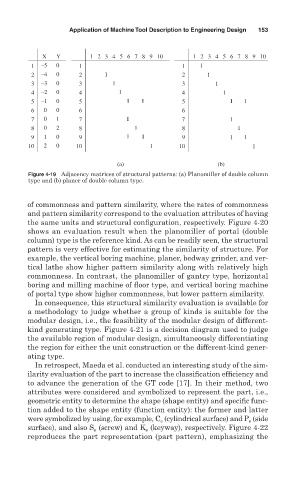
                Figure 4-19    Adjacency matrices of structural patterns: (a) Planomiller of double column
                type and (b) planer of double column type.


               of commonness and pattern similarity, where the rates of commonness
               and pattern similarity correspond to the evaluation attributes of having
               the same units and structural configuration, respectively. Figure 4-20
               shows an evaluation result when the planomiller of portal (double
               column) type is the reference kind. As can be readily seen, the structural
               pattern is very effective for estimating the similarity of structure. For
               example, the vertical boring machine, planer, bedway grinder, and ver-
               tical lathe show higher pattern similarity along with relatively high
               commonness. In contrast, the planomiller of gantry type, horizontal
               boring and milling machine of floor type, and vertical boring machine
               of portal type show higher commonness, but lower pattern similarity.
                 In consequence, this structural similarity evaluation is available for
               a methodology to judge whether a group of kinds is suitable for the
               modular design, i.e., the feasibility of the modular design of  different-
               kind generating type. Figure 4-21 is a decision diagram used to judge
               the available region of modular design, simultaneously differentiating
               the region for either the unit construction or the  different-kind gener-
               ating type.
                 In retrospect, Maeda et al. conducted an interesting study of the sim-
               ilarity evaluation of the part to increase the classification efficiency and
               to advance the generation of the GT code [17]. In their method, two
               attributes were considered and symbolized to represent the part, i.e.,
               geometric entity to determine the shape (shape entity) and specific func-
               tion added to the shape entity (function entity): the former and latter
               were symbolized by using, for example, C (cylindrical surface) and P (side
                                                                           e
                                                   e
               surface), and also S (screw) and K (keyway), respectively. Figure 4-22
                                               e
                                 e
               reproduces the part representation (part pattern), emphasizing the

