


Page 189 - Modular design for machine tools
P. 189
Application of Machine Tool Description to Engineering  Design    149

               In this computation, a further problem is to identify the leading errors
               within the traveling and rotational movements depending on the kinds
               and types of machine tool so as to simplify the computation. In retro-
               spect, this transfer matrix operation was used to estimate the cutter
               location in the universal head in the traditional milling machine in the
               1960s. In addition, Yokoyama and his colleagues conducted a similar
               research into the generation of the machine structure [15].


               4.2    Application of Structural  Description
               Although the functional description guarantees the ease of use, it is diffi-
               cult to provide the detail of the structural configuration, apart from that
               of Saljé and Redeker, together with the dimensional specifications. To
               overcome this disadvantageous feature, the structural description is rec-
               ommended rather than the functional description. Actually, we need to
               have deep (tacit) knowledge about the machine tool structure and to
               manage some tedious work when using the structural description. In con-
               trast, the structural description contains more design information than the
               functional description: The structural description has higher potential to
               establish the methodology for the structural design of machine tools.
                 To understand such a potential, a simple application will be stated
               below in which the structural configuration is classified on the basis of
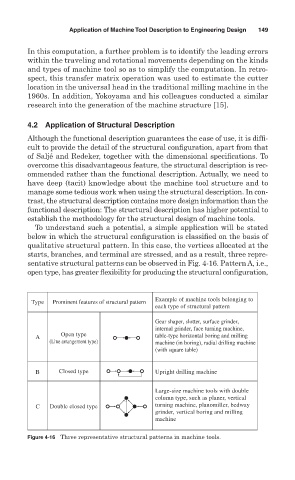
               qualitative structural pattern. In this case, the vertices allocated at the
               starts, branches, and terminal are stressed, and as a result, three repre-
               sentative structural patterns can be observed in Fig. 4-16. Pattern A, i.e.,
               open type, has greater flexibility for producing the structural configuration,


                                                  Example of machine tools belonging to
                Type  Prominent features of structural pattern
                                                  each type of structural pattern
                                                  Gear shaper, slotter, surface grinder,
                                                  internal grinder, face turning machine,
                        Open type
                  A                               table-type horizontal boring and milling
                     (Line arrangement type)      machine (in boring), radial drilling machine
                                                  (with square table)

                  B     Closed type               Upright drilling machine


                                                  Large-size machine tools with double
                                                  column type, such as planer, vertical
                  C  Double closed type           turning machine, planomiller, bedway
                                                  grinder, vertical boring and milling
                                                  machine

               Figure 4-16    Three representative structural patterns in machine tools.

