


Page 451 - Book Hosokawa Nanoparticle Technology Handbook
P. 451
1 DISPERSION OF FINE SILICA PARTICLES                                         APPLICATIONS
                  3. Unmeltable plastics: epoxy resin hybrid     substrates of silica, this hybrid material is utilized as a
                                                                 base material for various industrial applications. As for
                  The properties of polymer materials are heavily deteri-  the electrical insulation material related with the printed
                  orated when the temperature exceeds Tg (glass transi-  board, its high heat-resistance and good electrical insu-
                  tion temperature) and is softened. In addition, there is  lating property are highly evaluated and used for resist
                  increasing need for heat-resistant and flame-retarded  ink, electric resistant resin between the build-up board
                  epoxy resins in advanced fields such as the electronic  layers and reinforcing materials.
                  device industry as halogenated epoxy resin may  For semiconductors, this hybrid material is being
                  become unusable because of environmental issues.  used as a heat-resisting component for anisotropic
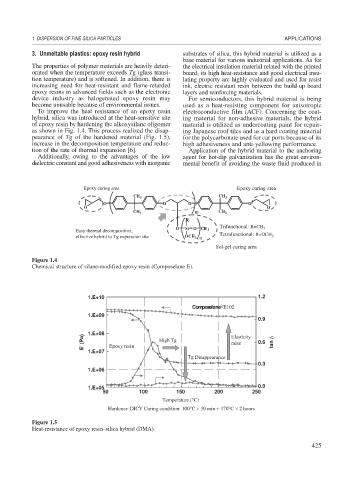
                    To improve the heat resistance of an epoxy resin  electroconductive film (ACF). Concerning the coat-
                  hybrid, silica was introduced at the heat-sensitive site  ing material for non-adhesive materials, the hybrid
                  of epoxy resin by hardening the alkoxysilane oligomer  material is utilized as undercoating paint for repair-
                  as shown in Fig. 1.4. This process realized the disap-  ing Japanese roof tiles and as a hard coating material
                  pearance of  Tg of the hardened material (Fig. 1.5),  for the polycarbonate used for car ports because of its
                  increase in the decomposition temperature and reduc-  high adhesiveness and anti-yellowing performance.
                  tion of the rate of thermal expansion [6].      Application of the hybrid material to the anchoring
                    Additionally, owing to the advantages of the low  agent for hot-dip galvanization has the great environ-
                  dielectric constant and good adhesiveness with inorganic  mental benefit of avoiding the waste fluid produced in


                                  Epoxy curing area                              Epoxy curing area
                                                 CH                         CH
                                                   3                          3
                                        O                 O O     O O                O
                                  O                                                        O
                                                 CH                 m m     CH
                                                   3                          3
                                                                 R
                                                                            Trifunctional: R=CH
                                                              O  Si  O CH                3
                               Easy thermal decomposition,          O CH 3 3
                                                                            Tetrafunctional: R=OCH
                               effective hybrid to Tg expression site  OCH 3 n              3
                                                                           Sol-gel curing area
                  Figure 1.4
                  Chemical structure of silane-modified epoxy resin (Composelane E).


                                   1.E+10                                               1.2
                                                                   Composelane ® E102
                                   1.E+09
                                                                                        0.9

                                   1.E+08                                       Elasticity
                                  E′ (Pa)  Epoxy resin   High Tg                raise   0.6  tan δ  δ
                                   1.E+07
                                                                  Tg Disappearance
                                                                                        0.3
                                   1.E+06

                                   1.E+05                                               0.0
                                        50         100         150        200         250
                                                          Temperature (°C)
                                         Hardener: DICY Curing condition: 100°C × 30 min + 170°C × 2 hours

                  Figure 1.5
                  Heat-resistance of epoxy resin–silica hybrid (DMA).

                                                                                                        425

