


Page 116 - Neural Network Modeling and Identification of Dynamical Systems
P. 116
3.4 ANN-BASED CONTROL OF DYNAMICAL SYSTEMS               105
                          system (see, for example, [63–66]), has the form  locity of the pitch q andthepitchangle θ can be
                                                                       carried out using the assumption V = const. In
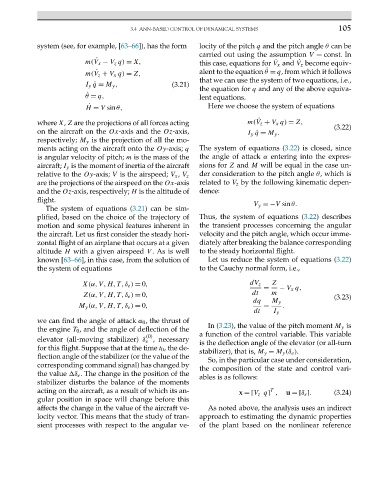
                                       m(V x − V z q) = X,             this case, equations for V x and V z become equiv-
                                          ˙
                                                                                                  ˙
                                                                                            ˙
                                                                                         ˙
                                       m(V z + V x q) = Z,             alent to the equation θ = q, from which it follows
                                          ˙
                                                                       that we can use the system of two equations, i.e.,
                                       I y ˙q = M y ,          (3.21)
                                                                       theequationfor q and any of the above equiva-
                                       θ = q,                          lent equations.
                                       ˙
                                        ˙
                                       H = V sinθ,                       Here we choose the system of equations
                                                                                       ˙
                          where X, Z are the projections of all forces acting       m(V z + V x q) = Z,
                                                                                                            (3.22)
                          on the aircraft on the Ox-axis and the Oz-axis,           I y ˙q = M y .
                          respectively; M y is the projection of all the mo-
                          ments acting on the aircraft onto the Oy-axis; q  The system of equations (3.22) is closed, since
                          is angular velocity of pitch; m is the mass of the  the angle of attack α entering into the expres-
                          aircraft; I y is the moment of inertia of the aircraft  sions for Z and M will be equal in the case un-
                                                                       der consideration to the pitch angle θ,which is
                          relative to the Oy-axis; V is the airspeed; V x , V z
                          are the projections of the airspeed on the Ox-axis  related to V z by the following kinematic depen-
                          and the Oz-axis, respectively; H is the altitude of  dence:
                          flight.
                                                                                      V y =−V sinθ.
                            The system of equations (3.21) can be sim-
                          plified, based on the choice of the trajectory of  Thus, the system of equations (3.22) describes
                          motion and some physical features inherent in  the transient processes concerning the angular
                          the aircraft. Let us first consider the steady hori-  velocity and the pitch angle, which occur imme-
                          zontal flight of an airplane that occurs at a given  diately after breaking the balance corresponding
                          altitude H with a given airspeed V .Asiswell  to the steady horizontal flight.
                          known [63–66], in this case, from the solution of  Let us reduce the system of equations (3.22)
                          the system of equations                      to the Cauchy normal form, i.e.,

                                      X(α,V,H,T,δ e ) = 0,                           dV z  Z
                                                                                         =   − V x q,
                                       Z(α,V,H,T,δ e ) = 0,                          dt    m                (3.23)
                                                                                      dq   M y
                                     M y (α,V,H,T,δ e ) = 0,                             =    .
                                                                                      dt   I y
                          we can find the angle of attack α 0 ,the thrust of
                                                                         In (3.23), the value of the pitch moment M y is
                          the engine T 0 , and the angle of deflection of the
                                                        (0)            a function of the control variable. This variable
                          elevator (all-moving stabilizer) δ e , necessary  is the deflection angle of the elevator (or all-turn
                          for this flight. Suppose that at the time t 0 ,thede-  stabilizer), that is, M y = M y (δ e ).
                          flection angle of the stabilizer (or the value of the  So, in the particular case under consideration,
                          corresponding command signal) has changed by  the composition of the state and control vari-
                          the value  δ e . The change in the position of the
                                                                       ablesisasfollows:
                          stabilizer disturbs the balance of the moments
                          acting on the aircraft, as a result of which its an-    x =[V z q] ,  u =[δ e ].  (3.24)
                                                                                          T
                          gular position in space will change before this
                          affects the change in the value of the aircraft ve-  As noted above, the analysis uses an indirect
                          locity vector. This means that the study of tran-  approach to estimating the dynamic properties
                          sient processes with respect to the angular ve-  of the plant based on the nonlinear reference

