Page 352 - PRINCIPLES OF QUANTUM MECHANICS as Applied to Chemistry and Chemical Physics
P. 352
Evaluation of two-electron interaction interval      343
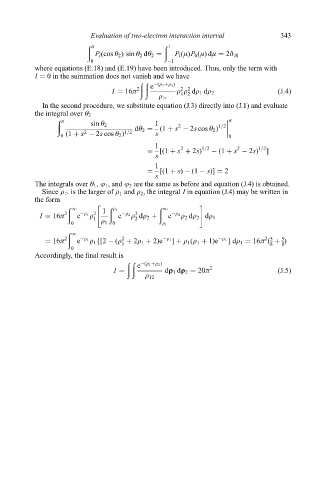
                                       ð                     1
                                      …                     …
                                        P l (cos è 2 ) sin è 2 dè 2 ˆ  P l (ì)P 0 (ì)dì ˆ 2ä l0
                                       0                     ÿ1
                        where equations (E.18) and (E.19) have been introduced. Thus, only the term with
                        l ˆ 0 in the summation does not vanish and we have
                                                     ……  e ÿ(r 1 ‡r 2 )
                                                                2 2
                                             I ˆ 16ð 2         r r dr 1 dr 2                (J:4)
                                                                1 2
                                                          r .
                          In the second procedure, we substitute equation (J.3) directly into (J.1) and evaluate
                        the integral over è 2
                               ð
                              …                                                ð
                                       sin è 2           1      2
                                                    dè 2 ˆ (1 ‡ s ÿ 2s cos è 2 )  1=2
                                     2
                               0 (1 ‡ s ÿ 2s cos è 2 ) 1=2  s                  0
                                                         1      2     1=2       2     1=2
                                                       ˆ [(1 ‡ s ‡ 2s)   ÿ (1 ‡ s ÿ 2s)  ]
                                                         s
                                                         1
                                                       ˆ [(1 ‡ s) ÿ (1 ÿ s)] ˆ 2
                                                         s
                        The integrals over è 1 , j 1 , and j 2 are the same as before and equation (J.4) is obtained.
                          Since r . is the larger of r 1 and r 2, the integral I in equation (J.4) may be written in
                        the form
                                         "                            #
                                 …          …             …
                                  1       1  r 1           1
                         I ˆ 16ð 2  e ÿr 1 2 1  e ÿr 2 2 2   e ÿr 2  r 2 dr 2 dr 1
                                       r
                                                  r dr 2 ‡
                                  0       r 1 0            r 1
                                 …
                                  1
                                                2
                          ˆ 16ð 2  e ÿr 1 r 1 f[2 ÿ (r ‡ 2r 1 ‡ 2)e ÿr 1 ] ‡ r 1 (r 1 ‡ 1)e ÿr 1 g dr 1 ˆ 16ð ( ‡ )
                                                                                             5
                                                                                        2 5
                                                1
                                                                                         8
                                                                                             8
                                  0
                        Accordingly, the ®nal result is
                                                 ……  ÿ(r 1 ‡r 2 )
                                                    e                    2
                                              I ˆ           drr 1 drr 2 ˆ 20ð               (J:5)
                                                      r 12
   347   348   349   350   351   352   353   354   355   356   357