


Page 347 - PRINCIPLES OF QUANTUM MECHANICS as Applied to Chemistry and Chemical Physics
P. 347
338 Appendix I
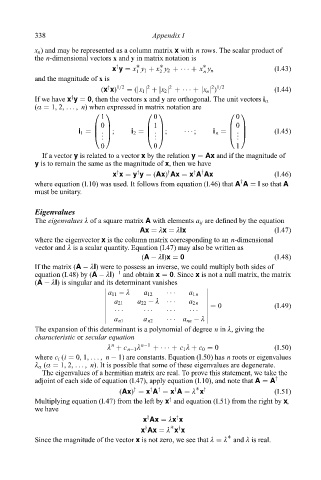
x n ) and may be represented as a column matrix x with n rows. The scalar product of
the n-dimensional vectors x and y in matrix notation is
y
x y x y 1 x y 2 x y n (I:43)
1 2 n
and the magnitude of x is
2 1=2
2
2
y
(x x) 1=2 (jx 1 j jx 2 j j x n j ) (I:44)
y
If we have x y 0, then the vectors x and y are orthogonal. The unit vectors i á
(á 1, 2, ... , n) when expressed in matrix notation are
0 1 0 1 0 1
1 0 0
B 0 C B 1 C B 0 C
.
.
.
i 1 B C ; i 2 B C ; ; i n B C (I:45)
. . .
@ . A @ . A @ . A
0 0 1
If a vector y is related to a vector x by the relation y Ax and if the magnitude of
y is to remain the same as the magnitude of x, then we have
y
y
y
y
x x y y (Ax) Ax x A Ax (I:46)
y
y
where equation (I.10) was used. It follows from equation (I.46) that A A I so that A
must be unitary.
Eigenvalues
The eigenvalues ë of a square matrix A with elements a ij are de®ned by the equation
Ax ëx ëIx (I:47)
where the eigenvector x is the column matrix corresponding to an n-dimensional
vector and ë is a scalar quantity. Equation (I.47) may also be written as
(A ÿ ëI)x 0 (I:48)
If the matrix (A ÿ ëI) were to possess an inverse, we could multiply both sides of
equation (I.48) by (A ÿ ëI) ÿ1 and obtain x 0. Since x is not a null matrix, the matrix
(A ÿ ëI) is singular and its determinant vanishes
a 11 ÿ ë
a 12 a 1n
a 22 ÿ ë
a 21 a 2n
0 (I:49)
a nn ÿ ë
a n1 a n2
The expansion of this determinant is a polynomial of degree n in ë, giving the
characteristic or secular equation
n
ë c nÿ1 ë nÿ1 c 1 ë c 0 0 (I:50)
where c i (i 0, 1, .. . , n ÿ 1) are constants. Equation (I.50) has n roots or eigenvalues
ë á (á 1, 2, ... , n). It is possible that some of these eigenvalues are degenerate.
The eigenvalues of a hermitian matrix are real. To prove this statement, we take the
adjoint of each side of equation (I.47), apply equation (I.10), and note that A A y
y
(Ax) x A x A ë x (I:51)
y
y
y
y
Multiplying equation (I.47) from the left by x and equation (I.51) from the right by x,
y
we have
x Ax ëx x
y
y
x Ax ë x x
y
y
Since the magnitude of the vector x is not zero, we see that ë ë and ë is real.

