Page 345 - PRINCIPLES OF QUANTUM MECHANICS as Applied to Chemistry and Chemical Physics
P. 345
336                              Appendix I

                             It follows from equation (I.27) that the product of two non-singular matrices is also
                             non-singular.


                             Special square matrices
                                               ^
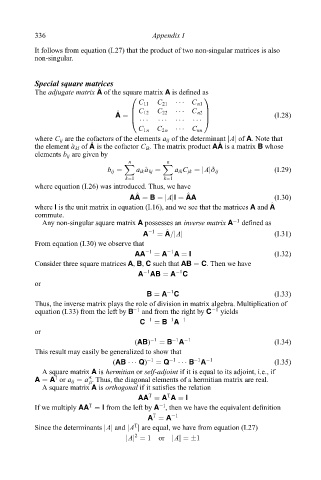
                             The adjugate matrix A of the square matrix A is de®ned as
                                                        0                   1
                                                          C 11  C 21        C n1
                                                    ^   B  C 12  C 22        C n2  C
                                                    A ˆ  B                  C                   (I:28)
                                                        @                       A
                                                          C 1n  C 2n        C nn
                             where C ij are the cofactors of the elements a ij of the determinant jAj of A. Note that
                                            ^
                                                                                ^
                             the element ^ a kl of A is the cofactor C lk . The matrix product AA is a matrix B whose
                             elements b ij are given by
                                                       n          n
                                                      X          X
                                                 b ij ˆ  a ik ^ a kj ˆ  a ik C jk ˆjAjä ij      (I:29)
                                                      kˆ1        kˆ1
                             where equation (I.26) was introduced. Thus, we have
                                                         ^
                                                                       ^
                                                       AA ˆ B ˆjAjI ˆ AA                        (I:30)
                                                                                               ^
                             where I is the unit matrix in equation (I.16), and we see that the matrices A and A
                             commute.
                               Any non-singular square matrix A possesses an inverse matrix A ÿ1  de®ned as
                                                                  ^
                                                           A ÿ1  ˆ A=jAj                        (I:31)
                             From equation (I.30) we observe that
                                                                  ÿ1
                                                         AA ÿ1  ˆ A A ˆ I                       (I:32)
                             Consider three square matrices A, B, C such that AB ˆ C. Then we have
                                                           ÿ1
                                                                    ÿ1
                                                          A AB ˆ A C
                             or
                                                                  ÿ1
                                                            B ˆ A C                             (I:33)
                             Thus, the inverse matrix plays the role of division in matrix algebra. Multiplication of
                             equation (I.33) from the left by B ÿ1  and from the right by C ÿ1  yields
                                                                  ÿ1
                                                          C ÿ1  ˆ B A ÿ1
                             or
                                                                   ÿ1
                                                         (AB) ÿ1  ˆ B A ÿ1                      (I:34)
                             This result may easily be generalized to show that
                                                                         ÿ1
                                                   (AB      Q) ÿ1  ˆ Q ÿ1      B A ÿ1           (I:35)
                               A square matrix A is hermitian or self-adjoint if it is equal to its adjoint, i.e., if

                             A ˆ A or a ij ˆ a . Thus, the diagonal elements of a hermitian matrix are real.
                                   y
                                            ji
                               A square matrix A is orthogonal if it satis®es the relation
                                                             T
                                                                  T
                                                          AA ˆ A A ˆ I
                                                                ÿ1
                                            T
                             If we multiply AA ˆ I from the left by A , then we have the equivalent de®nition
                                                              T
                                                             A ˆ A ÿ1
                                                         T
                             Since the determinants jAj and jA j are equal, we have from equation (I.27)
                                                         2
                                                      jAj ˆ 1   or  jAjˆÐ 1
   340   341   342   343   344   345   346   347   348   349   350