Page 341 - PRINCIPLES OF QUANTUM MECHANICS as Applied to Chemistry and Chemical Physics
P. 341
332                              Appendix I
                                            0                                             1
                                              a 11 b 11 ‡ a 12 b 21 ‡ a 13 b 31  a 11 b 12 ‡ a 12 b 22 ‡ a 13 b 32
                                      AB ˆ  @  a 21 b 11 ‡ a 22 b 21 ‡ a 23 b 31  a 21 b 12 ‡ a 22 b 22 ‡ a 23 b 32  A
                                              a 31 b 11 ‡ a 32 b 21 ‡ a 33 b 31  a 31 b 12 ‡ a 32 b 22 ‡ a 33 b 32
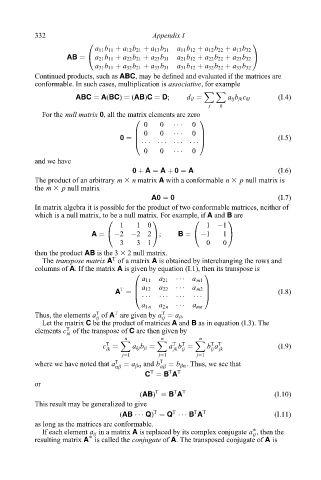
                             Continued products, such as ABC, may be de®ned and evaluated if the matrices are
                             conformable. In such cases, multiplication is associative, for example
                                                                            X X
                                        ABC ˆ A(BC) ˆ (AB)C ˆ D;       d il ˆ      a ij b jk c kl  (I:4)
                                                                              j  k
                               For the null matrix 0, all the matrix elements are zero
                                                         0                 1
                                                            0   0        0
                                                         B  0   0        0  C
                                                     0 ˆ  B                C                     (I:5)
                                                         @                 A

                                                            0   0        0
                             and we have
                                                        0 ‡ A ˆ A ‡ 0 ˆ A                        (I:6)
                             The product of an arbitrary m 3 n matrix A with a conformable n 3 p null matrix is
                             the m 3 p null matrix
                                                              A0 ˆ 0                             (I:7)
                             In matrix algebra it is possible for the product of two conformable matrices, neither of
                             which is a null matrix, to be a null matrix. For example, if A and B are
                                                 0            1          0         1
                                                     1   1   0               1  ÿ1
                                             A ˆ  @  ÿ2 ÿ2   2  A ;  B ˆ  @  ÿ1   1  A
                                                     3   3   1               0    0
                             then the product AB is the 3 3 2 null matrix.
                                                   T
                               The transpose matrix A of a matrix A is obtained by interchanging the rows and
                             columns of A. If the matrix A is given by equation (I.1), then its transpose is
                                                         0                  1
                                                           a 11  a 21       a m1
                                                     T   B  a 12  a 22       a m2  C
                                                   A ˆ   B                  C                    (I:8)
                                                         @                  A

                                                           a 1n  a 2n       a mn
                                                   T
                                                                T
                                              T
                             Thus, the elements a of A are given by a ˆ a ji .
                                              ij                 ij
                               Let the matrix C be the product of matrices A and B as in equation (I.3). The
                                      T
                             elements c of the transpose of C are then given by
                                      ik
                                                      n         n          n
                                                     X         X          X
                                                 T                  T  T      T T
                                                c ˆ     a kj b ji ˆ  a b ˆ   b a                 (I:9)
                                                 ik                 jk ij     ij  jk
                                                     jˆ1        jˆ1       jˆ1
                             where we have noted that a T  ˆ a âá and b T  ˆ b âá . Thus, we see that
                                                   áâ           áâ
                                                                  T
                                                             T
                                                            C ˆ B A  T
                             or
                                                                    T
                                                               T
                                                          (AB) ˆ B A  T                         (I:10)
                             This result may be generalized to give
                                                                    T
                                                              T
                                                                         T
                                                     (AB     Q) ˆ Q     B A T                   (I:11)
                             as long as the matrices are conformable.

                               If each element a ij in a matrix A is replaced by its complex conjugate a , then the
                                                                                          ij

                             resulting matrix A is called the conjugate of A. The transposed conjugate of A is
   336   337   338   339   340   341   342   343   344   345   346